
You can be in a café, a supermarket aisle, on a train platform, anywhere normal really, and half your attention is already doing that quiet scanning job. Where are the exits, where are the toilets, how far is it, what if the queue is long, what if I get stuck here. It is exhausting, and it is also strangely automatic, like your mind starts doing it before you have even chosen to.
If journeys are your biggest trigger, have a look at toilet anxiety when travelling, it focuses specifically on cars, trains, flights, holidays, and the fear of being stuck far from a toilet.
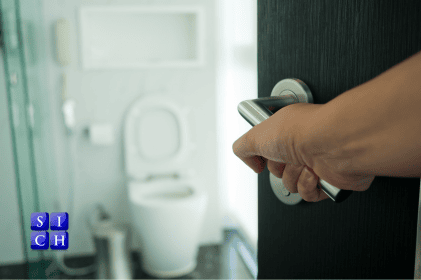
If you want the deeper clinical explanation of how we approach this, and what we actually do with the subconscious patterns underneath it, start with our main page on hypnotherapy for toilet anxiety.
“I’m constantly trying to stay in control, and I’m still scared.”
If that line hits a bit too hard, you are not alone. This is what people often mean when they search fight toilet anxiety, not one big dramatic moment, more like a constant background job where your day has to be managed “just in case”. And the frustrating part is that the more you try to stay on top of it, the more your body seems to argue back.
On this page
People rarely see the real workload. They just see you getting on with it, smiling, answering questions, looking fine. Meanwhile, inside, you are checking sensations like a dashboard, making micro decisions every few minutes, and quietly adjusting the plan so nothing “bad” can happen.
It might be scanning for toilets without wanting to, it might be choosing a seat near an exit, it might be walking a little faster, it might be keeping a mental map of the quickest route out. It can also turn into rules, don’t go there, don’t stay too long, don’t get stuck in the middle of a queue, always know where the next toilet is. Even when you do not want to live like this, it can feel automatic.
For many people this is not mainly about embarrassment or being watched. It is the fear of not reaching a toilet in time, of being trapped somewhere ordinary, and having the body set off an alarm at the worst possible moment. So you end up doing the job of staying in control, all day.
When Control Starts To Feel Non Negotiable
At first, control can feel like common sense. You have a scary moment, you do a bit more planning next time, and it feels responsible. The issue is that the brain does not always store it as “that was unpleasant”, it can store it as “that was dangerous”.
Once the nervous system learns danger, it becomes persuasive. It does not say, “I’m anxious”, it says, “This is a real risk, and we need to manage it.” It makes the stakes feel high. It makes you feel like relaxing is reckless. Some people even feel guilty if they break their own safety rules, as if they have failed some basic responsibility.
This is why “just let go of control” usually lands badly. It misses the point. The system is not trying to be controlling for the sake of it, it has learned that control is required for safety.
How The Fight Keeps The Alarm Switched On
Here is the catch. The constant monitoring and bracing is not neutral. To the nervous system, it can act like evidence. If you are checking, scanning, rehearsing, holding tension, and measuring every sensation, your brain quietly concludes, “We must still be in danger, otherwise we would not be doing all this.”
So the effort itself becomes a danger signal. Not because you are doing it wrong, but because the brain learns by association. If you only feel safe when you are controlling, then control becomes the condition for safety. That keeps the alarm system on standby, ready to fire the moment anything feels uncertain.
Then the loop bites. A normal sensation can feel urgent, the body tightens, breathing shifts, adrenaline moves, and suddenly it feels like the fear was right. The mind explains it, “See, I knew it”, so you fight harder, scan harder, brace harder. If you are searching fight toilet anxiety and nothing seems to stick, this is often why.
What Changes When Safety Stops Depending On Control
The shift is not “stop controlling and hope for the best”. That is basically asking your nervous system to do the one thing it believes is unsafe. The shift is retraining the alarm response, so your brain no longer treats ordinary places as if they are risky, and your body no longer reacts like it has to shout to keep you safe.
Real recovery tends to look like a gradual return to natural behaviour. Less checking, less bracing, fewer rules, more ordinary choices. Not because you are forcing yourself to be brave, but because the nervous system learns, through the right process, that you can live your life without constant management.
The Next Step
If you are fighting to stay in control and still feeling scared, the next step is not another rule. It is a clearer map of what you are stuck in, and a path out that does not rely on constant management.
Start here, anxious about needing the toilet, it explains the alarm loop in plain English and why common strategies backfire.
Then use our hypnotherapy for toilet anxiety, to see how we work with the deeper belief level changes that allow normal behaviour to return.
If you want a gentler starting point first, take the toilet anxiety assessment.