
Anxiety and panic can show up in many different ways.
For some people, anxiety and panic are part of daily life, showing up as worry, tension, dread or a constant feeling that something is not quite right. For others, panic appears suddenly in the body, with a racing heart, tight chest, dizziness, breathlessness, nausea, shaking or a fear that something terrible is about to happen.
Anxiety and panic can also become linked to particular situations, travelling, meetings, shops, public places, social events, being far from home, public speaking, toilet access, health worries, or places where leaving would feel difficult.

This page can help you find the anxiety and panic problem that best matches your situation. For a fuller explanation of how we work with anxiety patterns, safety behaviours and the anxiety loop, you can also read our main page on hypnotherapy for anxiety.
Find the anxiety and panic problem that fits your situation
This section helps you choose the page that best matches your experience, whether anxiety shows up as panic attacks, social anxiety, travel anxiety, agoraphobia, presentation nerves, toilet anxiety, health anxiety, or another anxiety-related pattern.
Hypnotherapy for anxiety and panic

Support for constant worry, racing thoughts and anxious patterns when it feels as if anxiety is running your life rather than the other way round.
How to deal with anxiety

Practical ways to understand anxious thoughts, calm physical symptoms and start changing the patterns that keep anxiety active.
Social anxiety and shyness

Help for blushing, self consciousness, fear of being judged and dread of parties, work events or any kind of social gathering.
Public speaking and performance nerves

Support for presentations, meetings, interviews, stage performances and wedding speeches when your body goes into full panic mode.
Travel anxiety and fear of getting stuck
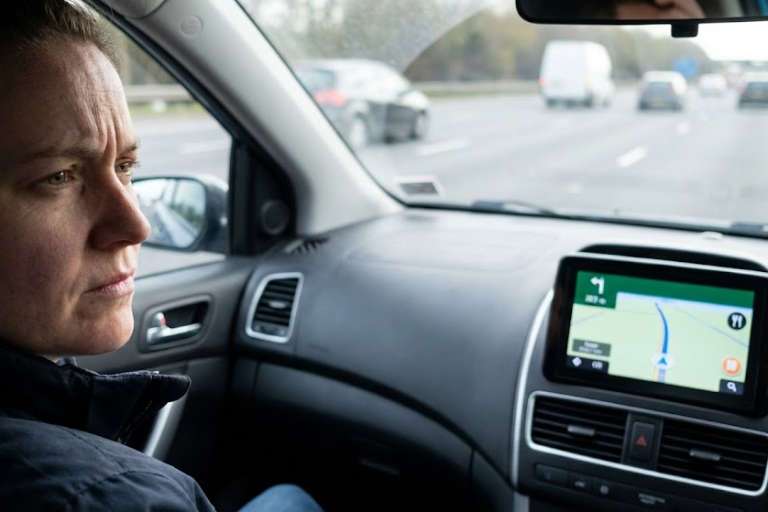
Help for anxiety about motorways, trains, planes or being far from home, especially the fear of feeling trapped or unable to get away.
Agoraphobia and fear of going out

Support when supermarkets, banks, cinemas, busy streets or even leaving the house have started to feel overwhelming or unsafe.
Anxiety and panic can feel different for different people
Anxiety is not always one clear thing. It can feel different from one person to another, and it can even feel different in different situations.
One person may feel anxious most of the time, with constant worry, tension and overthinking. Another may only feel anxious in specific situations, such as travelling, speaking in public, sitting in a meeting, going into a shop, eating out, or being somewhere they cannot easily leave.
Panic can feel more sudden and physical. It may come with a racing heart, breathlessness, dizziness, sweating, trembling, nausea, a tight chest, a feeling of unreality, or a fear that something awful is about to happen. For some people, the fear of having another panic attack becomes as limiting as the panic itself.
This is why it is not always enough to ask, “Do I have anxiety or panic?” A more useful question can be, “What is my anxiety or panic organised around?”
What is the difference between anxiety and panic?
Anxiety often builds through anticipation, worry, tension, avoidance or a sense that something may go wrong. It can be there in the background for hours, days or longer.
Panic is usually more intense and physical. It may feel as though the body has suddenly gone into emergency mode, even when there is no obvious danger. A panic attack can feel frightening because the sensations are so strong, and because they can appear to come out of nowhere.
In reality, anxiety and panic often overlap. Someone may worry for days before an event, then panic when they arrive. Another person may have one panic attack in a particular place, then become anxious about returning there. Over time, the fear of panic can start to shape decisions, routines and behaviour.
That is why anxiety and panic are often best understood together. The panic may be the most dramatic part, but the anxiety around it can be what keeps the problem going.
Why do anxiety and panic keep coming back?
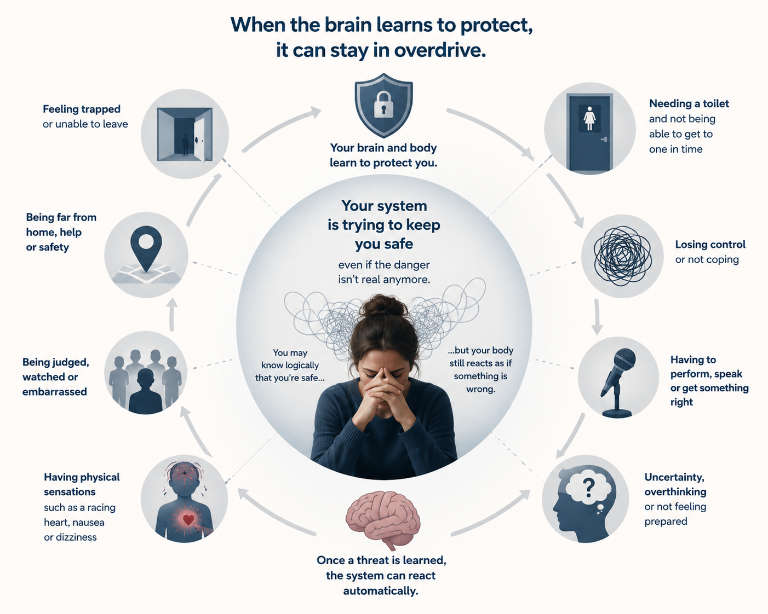
Anxiety and panic can keep coming back when the mind and body have learned to treat certain situations, sensations or possibilities as dangerous.
This does not mean the fear is silly. It means your system is trying to protect you, even if the protection has become too strong, too sensitive, or too easily triggered.
Once the system has learned that something is threatening, it may begin to react automatically. You may know logically that you are safe, but your body still reacts as if something is wrong.
- feeling trapped or unable to leave
- being far from home, help or safety
- being judged, watched or embarrassed
- having physical sensations such as a racing heart, nausea or dizziness
- needing a toilet and not being able to get to one in time
- losing control or not coping
- having to perform, speak or get something right
- uncertainty, overthinking or not feeling prepared
How anxiety and panic can start to affect everyday life
Most people with anxiety and panic do not simply sit and do nothing. They find ways to get through the day.
You may avoid certain places, sit near exits, check your body for symptoms, search for reassurance, plan routes carefully, avoid queues, carry things “just in case”, rehearse conversations, restrict food or drink, travel only with certain people, or make sure you always know how to get home.
These strategies can be understandable. They often reduce anxiety in the short term. The problem is that they can also teach the nervous system that you were only safe because you used them.
If you only feel safe because you avoided the situation, checked repeatedly, planned every detail, got reassurance, or kept an escape route ready, your mind may never learn that the situation was safer than it felt.
That is how anxiety and panic can quietly become more restrictive over time.
What if anxiety and panic do not fit neatly into one box?
Many people do not fit neatly into one anxiety category.
You may have panic attacks, but only when you are far from home. You may think you have travel anxiety, but the deeper fear may be panic sensations, toilet access, judgement, being trapped, or being unable to leave. You may think you have social anxiety, but the pattern may be performance pressure, overthinking, body alarm or fear of exposure.
The label can be useful, but it is not the whole picture.
At SICH, we often find it more useful to look at the pattern underneath anxiety and panic. That means asking what triggers the anxiety, what you fear might happen, what your body does in response, what you do to feel safer, and what may be keeping the loop active.
The free Anxiety Pattern Finder can help you start to make sense of this. It is not a diagnosis and it is not a formal psychological assessment. It is a tool designed to help you identify your main anxiety pattern, any secondary patterns, and the safety behaviours that may be keeping anxiety active.
How can hypnotherapy help with anxiety and panic?
Hypnotherapy for anxiety and panic is not about simply telling you to calm down or think more positively. Most people with anxiety have already tried to reason with themselves many times.
The work needs to take account of the automatic part of the response, the part that reacts before you have time to think it through clearly.
At The Surrey Institute of Clinical Hypnotherapy, we look at how your anxiety and panic are working as a pattern. We want to understand what your mind and body have learned to treat as threatening, how long the pattern has been running, what you do to cope, and what would need to change for your system to respond differently.
For some people, the main issue is the body alarm, the fear of panic sensations themselves. For others, it is control, certainty, distance from safety, judgement, performance pressure, toilet access, or overthinking.
Understanding that pattern helps us make the therapy more specific.
When should you get help for anxiety and panic?
It may be time to get help if anxiety and panic are starting to limit your life. That might mean you are avoiding places, cancelling plans, relying on safety behaviours, feeling unable to travel, struggling in work situations, avoiding social events, worrying about panic attacks, or constantly organising life around what anxiety might do next.
You do not have to wait until things are extreme. If anxiety and panic are shaping your choices more than you want them to, that is enough reason to start a conversation.
Talk to us about anxiety and panic
You do not need to have the perfect words before contacting us.
You can simply explain what has been happening, where anxiety or panic shows up, what you are avoiding, and what you would like to be able to do differently.
If anxiety or panic has started to limit your life, you are welcome to contact us and talk through whether hypnotherapy may be suitable for you.