
Interim clinical findings from 100 anonymised clinical cases
Overview
The SICH Toilet Anxiety Research Project is an ongoing clinical research project by The Surrey Institute of Clinical Hypnotherapy. It examines patterns found in anonymised clinical cases involving toilet anxiety, including symptom duration, presentation type, safety behaviours, perceived access threat and recorded physical diagnoses.
This toilet anxiety research is based on clients who attended The Surrey Institute of Clinical Hypnotherapy where toilet anxiety was the primary presenting problem. The cases included here are completed or closed cases, meaning each case had enough clinical information available for review and analysis.
This is not a population prevalence study. It does not tell us how common toilet anxiety is in the general public. It does, however, give a detailed picture of how toilet anxiety presents in a specialist clinical setting, what behaviours commonly maintain it, and why many people live with the condition for years before seeking the right help.
The central finding is not simply that toilet anxiety is distressing. That is already obvious to anyone who has experienced it. The more useful finding is that toilet anxiety appears to follow a recognisable pattern.
Many clients described different histories, different triggers and different degrees of disruption, yet the same themes appeared repeatedly: fear of needing a toilet and not getting to one in time, checking access, repeated toilet visits before leaving home, avoidance, restriction of food or drink, and a private mental calculation around distance, delay, escape and control.
Research Status
Project: SICH Toilet Anxiety Research Project
Current Stage: Interim clinical findings
Current Dataset: First 100 completed anonymised research cases
Status: Ongoing clinical data collection
Last Updated: July 2026
Next planned update: At 150 cases

Definition
For the purposes of this research, toilet anxiety is defined as a persistent fear of needing a toilet and not being able to get to one in time.
This is not the same as toilet phobia. Toilet phobia is a fear or avoidance of toilets themselves. Toilet anxiety, as described in this dataset, is usually about access, urgency, loss of control and uncertainty.
Common triggers include:
- lack of toilet access
- blocked toilet access
- delayed toilet access
- awkward toilet access
- uncertainty about toilet access
- being somewhere the person cannot easily leave
- being dependent on other people’s timing or decisions
This distinction matters clinically. A person with toilet anxiety may not be afraid of the toilet itself. They may be afraid of a traffic jam, a train journey, a queue, a meeting, a social event, a car journey, a restaurant, a cinema, a school run, a walk in the countryside, or any situation where getting to a toilet might not be immediate or straightforward.
In many cases, the fear is less about the toilet and more about whether the person can trust their body when access is uncertain.
Who this report is for
This research page is written primarily for clinicians, researchers, journalists and professionals who want a more detailed understanding of the SICH toilet anxiety dataset.
If you are looking for personal help, you may find the public facing resources easier to start with:
How We Collected the Data
The toilet anxiety research findings on this page are drawn from the first 100 completed or closed anonymised cases in the SICH Toilet Anxiety Research Project.
Clients were included where toilet anxiety was the primary presenting problem. The dataset includes people presenting with defecation-related anxiety, urination-related anxiety, or both. It also includes clients with and without recorded physical diagnoses such as IBS or other gastrointestinal or urological conditions.
Cases were reviewed using anonymised clinical information gathered through intake, assessment and treatment records. The aim was to identify recurring clinical patterns, not to produce a representative public survey.
Because this is a clinical dataset, the figures should be interpreted with care. They are useful for understanding the people who seek specialist help for toilet anxiety. They should not be used to claim population prevalence.
Limitations
These findings come from a specialist hypnotherapy clinic and may not represent everyone who experiences toilet anxiety.
There are several important limitations:
- The sample is help seeking, so it may overrepresent people whose symptoms are more disruptive.
- The data is based on clinical records and client self report, not a controlled trial.
- Some fields have missing or invalid responses, so some percentages are based on valid responses rather than the full 100 cases.
- The word “accident” is self interpreted by clients and may not mean exactly the same thing in every case.
- The dataset cannot prove causation.
- Treatment outcome figures are observational and should not be interpreted as evidence from a randomised controlled trial.
For readers considering the strength of this type of evidence, it is important to distinguish observational clinical findings from controlled trial evidence. Randomised controlled trials are generally used when researchers want to test causal treatment effects, while clinical datasets such as this one are better suited to identifying patterns that may warrant further investigation. Read more about randomised controlled trials and causal evidence.
These limitations do not make the findings unimportant. They simply define what the dataset can and cannot tell us. The value of this toilet anxiety research is in identifying repeated clinical patterns that warrant clearer recognition and further investigation.
Key Findings at a Glance
Based on the first 100 completed research cases included in the SICH Toilet Anxiety Research Project:
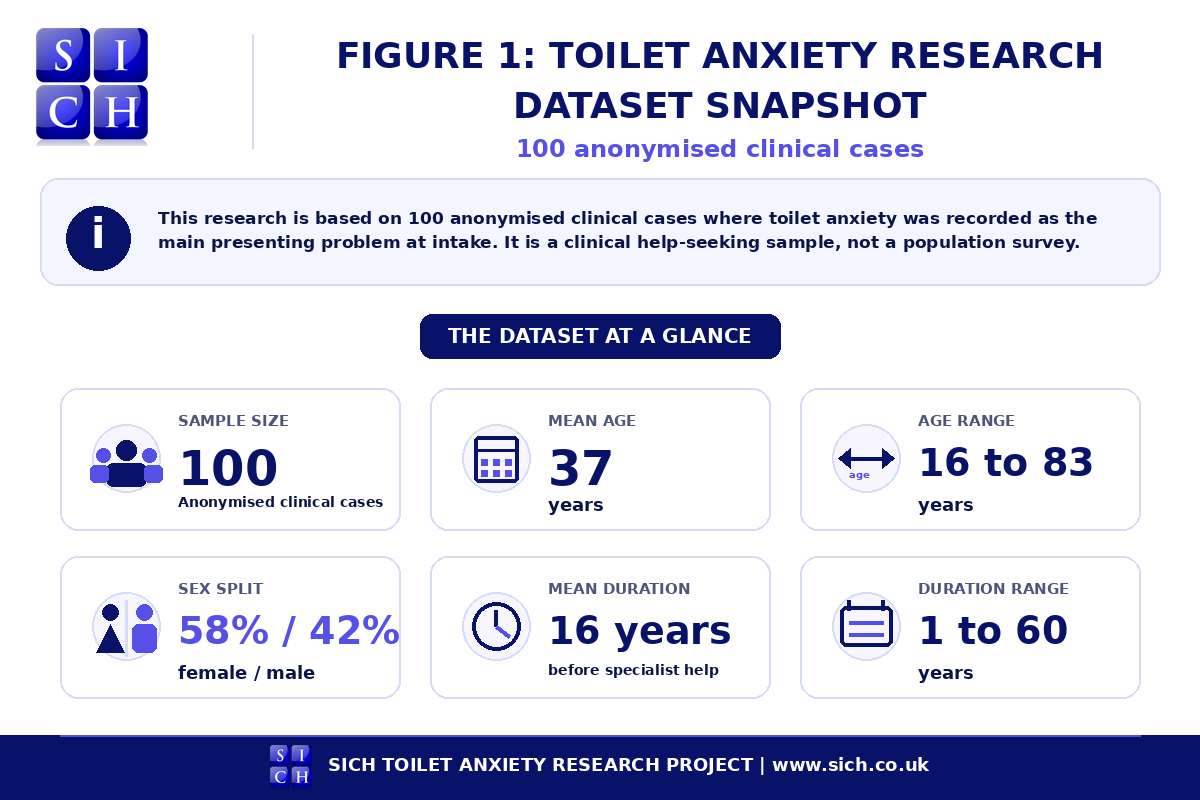
- Mean age at presentation was 37.32 years, rounded to 37.
- Median age was 34.
- The age range was 16 to 83.
- 58% of clients were female and 42% were male.
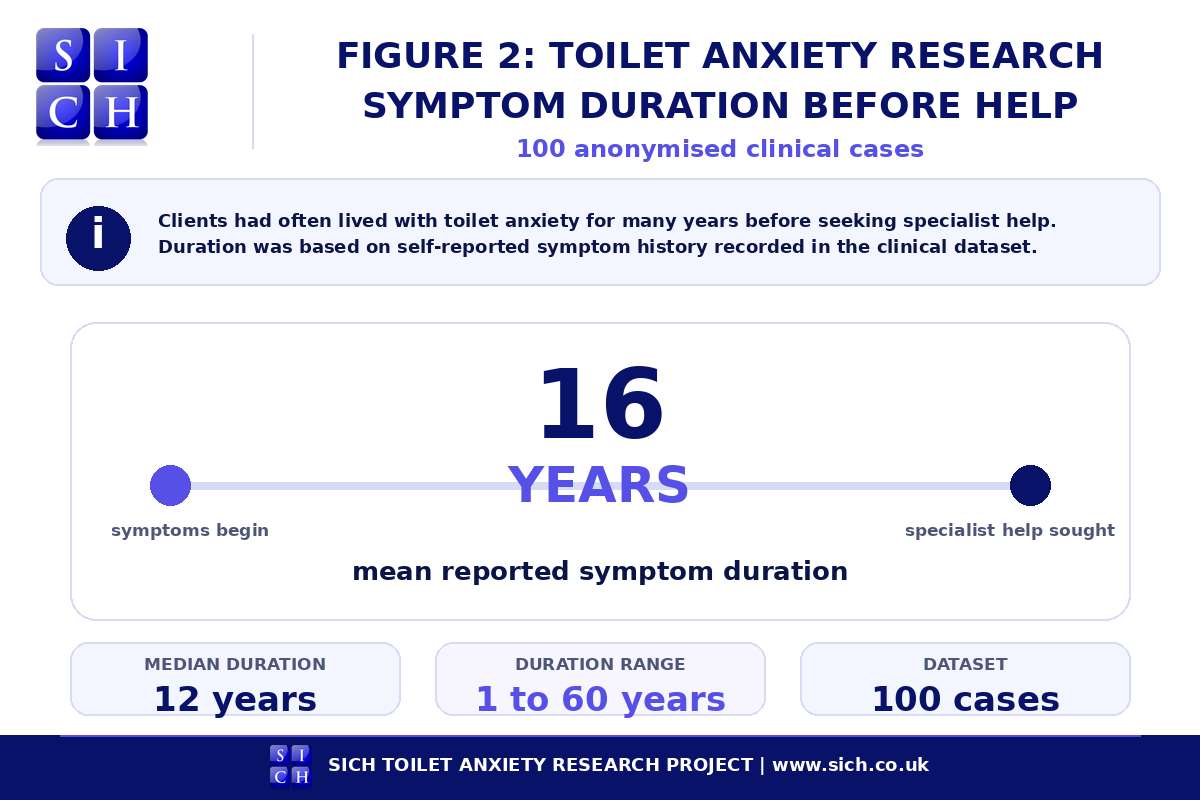
- Mean reported symptom duration was 15.815 years, rounded to 16 years.
- Median symptom duration was 12 years.
- Reported symptom duration ranged from 1 to 60 years.
- 76% reported no adult “accident”.
- 9% had a recorded IBS or physical diagnosis.
- 58% presented with defecation-related toilet anxiety.
- 23% presented with urination-related toilet anxiety.
- 19% presented with both defecation-related and urination-related toilet anxiety.
- 98% reported multiple toilet visits before leaving home.
- 91% reported toilet surfing or checking toilet access.
- 91% reported avoidance.
- 86% reported restricting food or drink.
- 85.9% reported using distraction, based on 99 valid responses.
- 49.0% reported medication use, based on 96 valid responses.
- 44% reported using an emergency bag.
- 100% of valid safety-behaviour cases reported at least one safety behaviour.
- The average number of sessions across all 100 closed cases was 4.96.
Demographic Profile And Symptom Duration
The mean age at presentation was 37.32 years, with a median age of 34 and an age range from 16 to 83.
This suggests that toilet anxiety is not confined to one stage of life. It appears across adolescence, early adulthood, midlife and later life. The condition may begin young for some clients, but it often remains active for many years before specialist help is sought.
The sex split in the dataset was 58% female and 42% male. This should not be interpreted as proof that toilet anxiety is more common in women. It may reflect differences in help seeking, disclosure, referral routes or the specific clinical population seen by the clinic.
The duration data is particularly important. The mean reported symptom duration was 15.815 years, rounded to 16 years. The median duration was 12 years, and the range was 1 to 60 years.
This means many clients had lived with toilet anxiety for more than a decade before seeking specialist help. In some cases, the problem had shaped travel, work, social life, relationships and everyday confidence for a very long time.
Clinically, this delay matters. The longer a person lives with toilet anxiety, the more their coping behaviours can become embedded. What may begin as occasional planning can gradually become a whole lifestyle built around prevention.
Clinical Typology
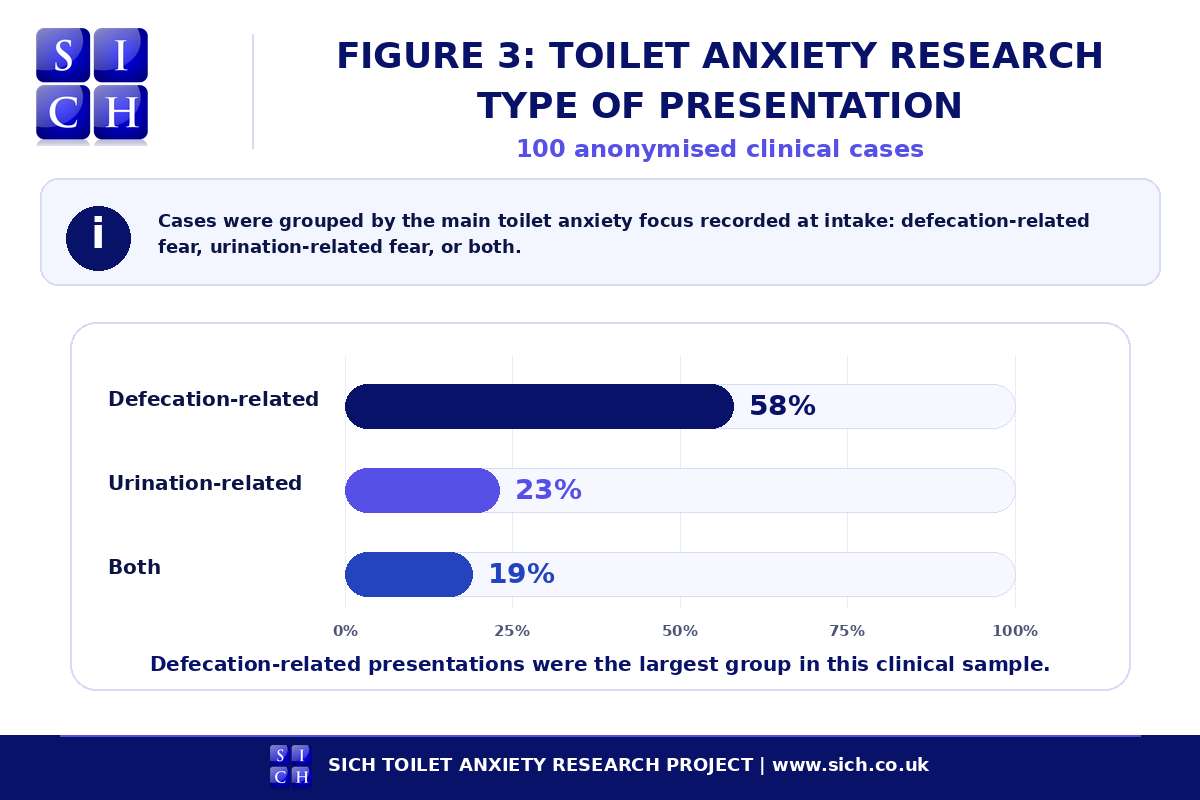
Clients were categorised by symptom focus:
- Defecation-related toilet anxiety: 58%
- Urination-related toilet anxiety: 23%
- Both defecation-related and urination-related toilet anxiety: 19%
This means 77% of cases involved defecation-related fear either on its own or alongside urination-related anxiety.
That does not mean urination-related toilet anxiety is minor. It can be highly restrictive, particularly when it involves travel, meetings, public transport, performance situations or anxiety about being unable to leave. However, within this clinical sample, defecation-related presentations were more common.
Defecation-related toilet anxiety often appeared to carry a heavier emotional load. Clients frequently described shame, disgust, fear of humiliation, fear of smell, fear of mess, fear of being trapped and fear that other people would discover what had happened.
This emotional burden may help explain why the problem is so often hidden. Many people do not simply avoid situations. They also avoid talking about why they avoid them.
Adult “Accident” History And Near Misses
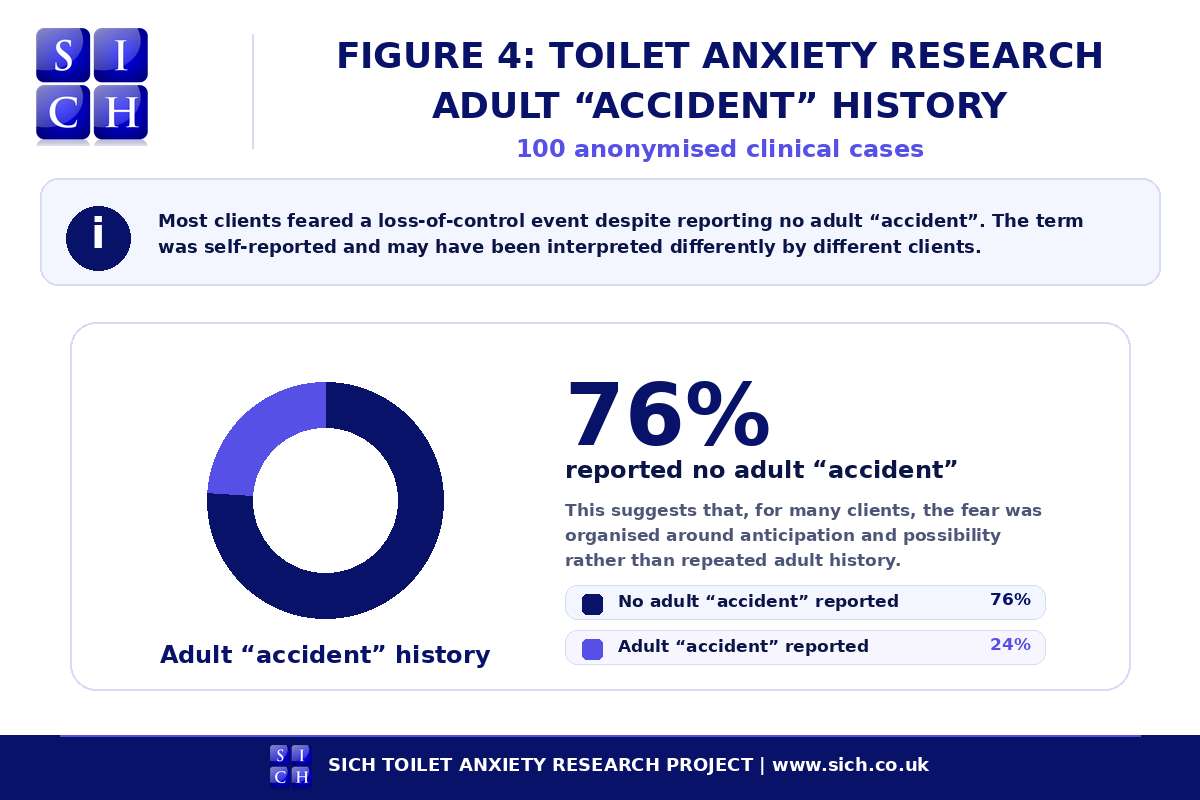
One of the most important findings is that 76% of clients reported no adult “accident”.
This matters because toilet anxiety is often experienced as though an accident is likely or imminent. Yet in this dataset, most clients did not report a repeated adult history of the feared outcome.
This does not make the fear irrational in a dismissive sense. The fear feels real because the body reacts as if danger is present. Urgency, adrenaline, scanning, tension and panic can all make the threat feel immediate.
However, the data suggests that, for many clients, toilet anxiety may be maintained by anticipation rather than repeated adult accidents.
Near misses appear to play an important clinical role. A near miss might involve barely reaching a toilet in time, feeling trapped in traffic with intense urgency, having to leave an event suddenly, or imagining how badly a situation could have gone. These experiences can be encoded as emotionally significant even when the feared outcome did not happen.
Over time, the mind may treat “I nearly did not make it” as evidence that “I might not make it next time”. That can create a powerful loop:
- A feared situation is anticipated
- The body becomes alert
- Urgency feels stronger
- The person escapes, checks or avoids
- Relief follows
- The brain learns that the safety behaviour prevented disaster
This is one reason reassurance often fails. Telling someone “you have always made it before” may be logically true, but it does not necessarily change the learned body-level prediction that next time could be different.
Treatment History And Therapeutic Outcomes
The average number of clinical hypnotherapy sessions across the 100 completed or closed cases was 4.96.
This is an observational clinical figure, not the result of a controlled treatment trial. It should be interpreted proportionately. It describes what happened within this specialist clinical dataset, not what every person with toilet anxiety should expect.
Even so, the contrast between symptom duration and treatment duration is clinically striking. The mean reported symptom duration was 15.815 years, rounded to 16 years, while the average number of sessions across all 100 closed cases was just under five.
That does not mean toilet anxiety is simple. Many clients had lived with the problem for years, and in some cases for decades. By the time they sought specialist help, the anxiety had often become woven into travel, work, social life, relationships and everyday decision-making.
One possible clinical interpretation is that toilet anxiety can remain entrenched for years when the maintaining mechanism is not correctly identified. Many clients had become highly skilled at managing the problem, but not at resolving it. They knew how to plan journeys, check toilet access, restrict food or drink, sit near exits, avoid uncertainty and leave situations early. In other words, they did not lack coping strategies. They had usually developed too many of them.
The treatment approach used by the clinic focused on changing the learned fear response and reducing dependence on safety behaviours, rather than simply giving clients additional ways to cope.
This remains an interim clinical observation. The outcome data should be viewed as an early signal from a specialist clinical dataset, not as a formal efficacy claim.
Safety Behaviours And Avoidance
Safety behaviours were one of the clearest patterns in the dataset.
Across valid safety-behaviour cases, 100% reported at least one safety behaviour. This does not mean every client used the same strategy, but it does suggest that toilet anxiety is strongly associated with behaviours designed to prevent, manage or escape the feared situation.
Commonly reported behaviours included:
- 98% reported multiple toilet visits before leaving home.
- 91% reported toilet surfing or checking toilet access.
- 91% reported avoidance.
- 86% reported restricting food or drink.
- 85.9% reported using distraction, based on 99 valid responses.
- 49.0% reported medication use, based on 96 valid responses.
- 44% reported using an emergency bag.
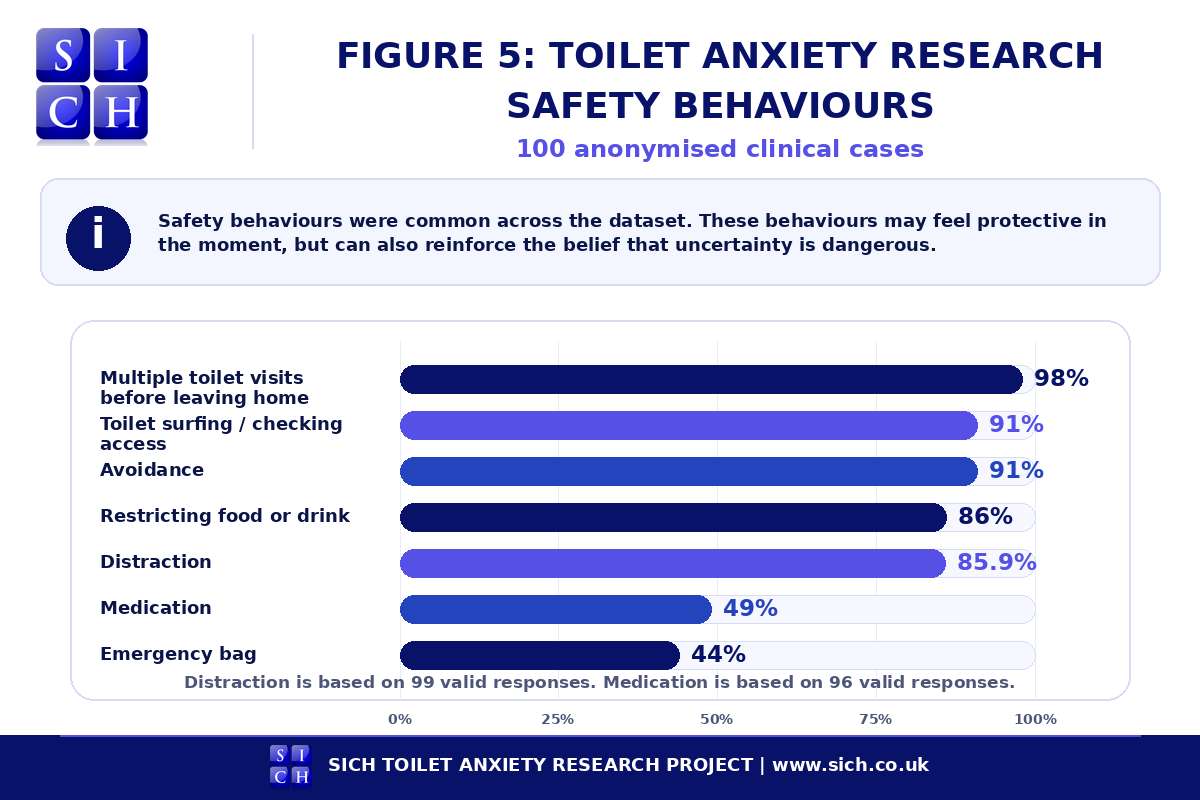
These behaviours usually make sense to the sufferer. If the person fears not reaching a toilet, then checking access, going repeatedly before leaving, limiting intake and carrying emergency supplies can feel logical.
The clinical problem is that these behaviours can reinforce the fear over time. Each behaviour may reduce anxiety in the short term, but it can also teach the brain that the person was only safe because the behaviour was performed.
This creates a difficult loop. The person feels safer because they have planned, checked or restricted. But the next time they face uncertainty, the need to plan, check or restrict may become even stronger.
Perceived Safety And The Ability To Delay
A recurring clinical observation was that urgency often changed depending on perceived safety.
Many clients described being better able to delay when they were at home, near a trusted toilet or in a situation where leaving would be easy. In contrast, urgency often became more intense when access was uncertain, delayed, awkward or socially difficult.
This suggests that toilet anxiety is not always a simple reflection of physical need. In many cases, the perception of access appears to influence the experience of urgency itself.
That distinction is clinically important. If urgency were always purely physical, then location, escape, social context and uncertainty would matter less. But in this dataset, those factors appeared repeatedly.
Clients often reported that the body seemed to behave differently depending on the situation. At home, they might delay. Before a journey, meeting, queue or event, the urge could feel immediate and difficult to trust.
This pattern supports the idea that toilet anxiety involves learned threat prediction. The nervous system may begin to treat uncertain access as danger. Once that danger signal is active, normal bodily sensations can become amplified and interpreted as warning signs.
Physical Diagnoses And IBS
9% of cases had a recorded IBS or physical diagnosis.
This does not mean that only 9% of people with toilet anxiety experience physical symptoms. Nor does it mean physical conditions are irrelevant. It means that, within this clinical dataset, 9% had a recorded IBS or physical diagnosis noted in the case material.
The finding should therefore be interpreted carefully. It suggests that, in this sample, most toilet anxiety presentations were not explained by a recorded physical diagnosis alone.
Some clients did have IBS, bowel symptoms, bladder symptoms or other physical factors. In those cases, physical symptoms may have contributed to the original development of fear. However, the ongoing anxiety often appeared to involve additional learned patterns: anticipation, scanning, avoidance, checking and loss of body trust.
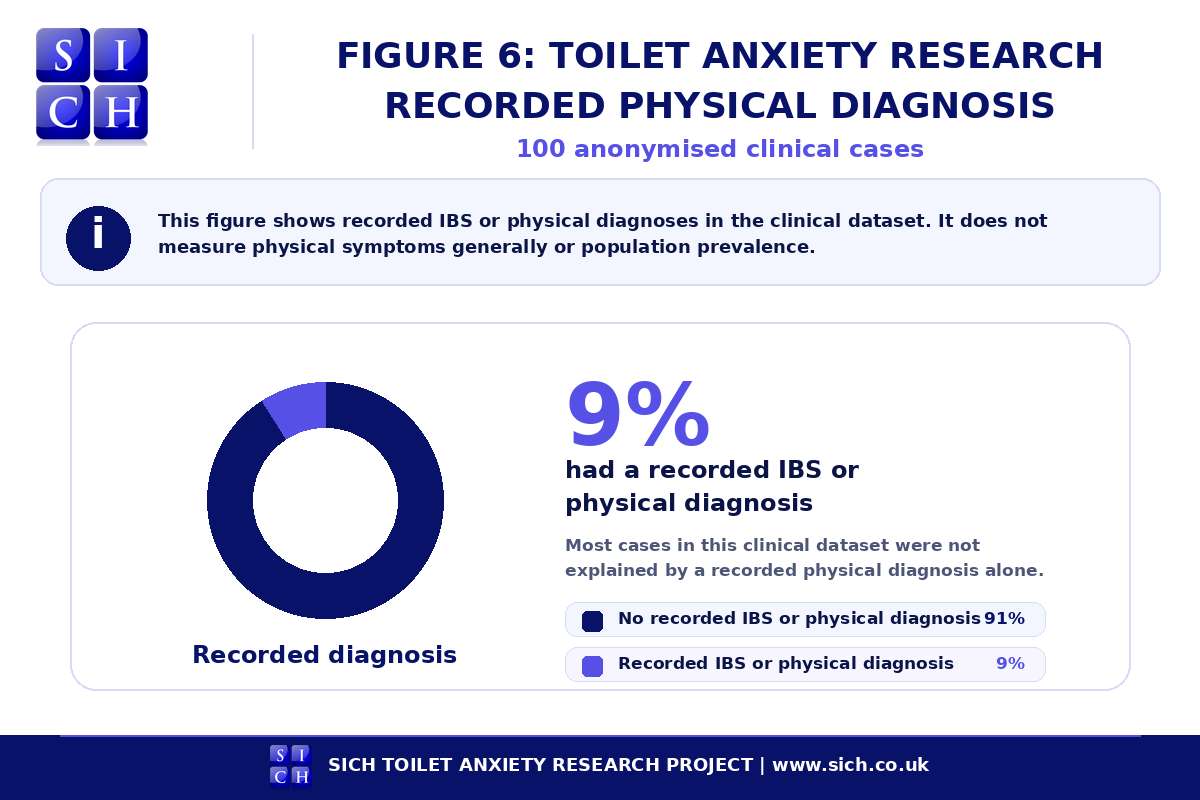
This is an important clinical distinction. Medical assessment remains important where symptoms are new, severe, unexplained or changing. But once appropriate medical checks have been made, anxiety may still need to be treated as anxiety, rather than as a purely physical problem.
Readers with new, severe, unexplained or changing bowel symptoms should seek appropriate medical advice. The NHS provides general information about irritable bowel syndrome and when to speak to a GP. NHS guidance on irritable bowel syndrome.
The purpose of this figure is not to minimise physical symptoms. It is to show that, in this clinical dataset, recorded physical diagnoses did not explain most toilet anxiety presentations on their own.
Behavioural And Cognitive Phenotypes
Taken together, the findings suggest that toilet anxiety is often maintained by a control and prediction loop.
The person fears needing the toilet and not being able to get there in time. They then try to reduce uncertainty by checking access, going repeatedly before leaving home, restricting food or drink, avoiding certain situations, carrying emergency items or planning an exit route.
These behaviours usually feel sensible. They often reduce anxiety in the short term. The difficulty is that they may also strengthen the belief that the person was only safe because the behaviour was performed.

Over time, the person may become increasingly sensitive to distance from home, distance from a known toilet, traffic, queues, meetings, public transport, restaurants, cinemas, theatres, walks, outdoor spaces, social events, travelling with other people, and situations where leaving would be embarrassing or controlled by someone else.
The common thread is not the toilet itself. It is the perceived inability to act quickly enough if the body demands it.
This is why toilet anxiety can look different from the outside. One person may avoid motorways. Another may avoid restaurants. Another may repeatedly leave meetings. Another may refuse holidays. Another may appear to go everywhere, but only after intense private planning.
The behaviour differs, but the underlying calculation is often the same: how far am I from safety, how quickly could I leave, and what would happen if my body needed a toilet before I could get to one?
This pattern supports the clinical view that toilet anxiety is often maintained by learned threat prediction. The nervous system begins to treat uncertain access as danger. Once that danger signal is active, normal bodily sensations may become amplified and interpreted as warning signs.
Clinical Conclusions
The first 100 completed or closed cases in the SICH Toilet Anxiety Research Project support several interim clinical observations.
- Toilet anxiety appears to be a long-standing and often hidden anxiety presentation.
- The average reported symptom duration was around 16 years.
- The condition affected people across a wide age range.
- Defecation-related presentations were more common than urination-only presentations in this sample.
- Most clients reported no adult “accident”.
- Safety behaviours were almost universal.
- Avoidance, toilet checking and repeated toilet visits before leaving home were especially common.
- A recorded IBS or physical diagnosis was present in 9% of cases.
- The average number of sessions across the 100 closed cases was 4.96.
The data suggests that toilet anxiety is often maintained by anticipation, learned threat prediction, avoidance and safety behaviours rather than by repeated adult accidents or recorded physical diagnosis alone.
These conclusions remain interim. They should be viewed as clinical observations from a specialist dataset, not definitive claims about all people with toilet anxiety or the wider population. Nevertheless, the consistency of the patterns observed across the first 100 completed research cases suggests they warrant further investigation as the project continues.
Implications For Practice
The findings suggest several practical implications for clinicians.
First, toilet anxiety should not be casually dismissed as embarrassment, overthinking or a simple dislike of public toilets. In many cases, the client is dealing with a highly organised fear system built around access, urgency and loss of control.
Second, asking only about toilets may miss the point. The more useful clinical questions often involve access and uncertainty:
- What happens when you cannot leave easily?
- What happens when toilet access is delayed?
- What journeys or situations do you plan around?
- What do you do before leaving home?
- What do you avoid?
- What are you frightened would happen if you could not get to a toilet quickly?
Third, clinicians should ask about safety behaviours. Repeated toilet visits, route checking, fluid restriction, food restriction, emergency bags, medication, distraction and exit planning may all be part of the maintaining pattern.
Fourth, reassurance alone is unlikely to be enough. Many clients already know, logically, that the feared outcome has not happened repeatedly. The problem is that the body does not feel convinced. Treatment may need to work with the learned threat response rather than relying only on conscious reasoning.
More broadly, NICE guidance on anxiety and panic disorder recognises the importance of appropriate assessment and evidence-based psychological approaches for anxiety presentations. NICE guidance on generalised anxiety disorder and panic disorder in adults.
Fifth, physical symptoms should be taken seriously without assuming they explain the whole presentation. Where appropriate, medical assessment remains important. But even when a physical condition is absent, stable or managed, the anxiety pattern may continue.
Future Research
The SICH Toilet Anxiety Research Project is ongoing, and this toilet anxiety research will be updated as the dataset grows.
The next planned update is at 150 completed cases.
Future analysis may explore:
- Differences between defecation-related and urination-related presentations
- The role of near misses
- The relationship between safety behaviours and symptom duration
- The difference between people with and without recorded physical diagnoses
- Treatment outcomes by subtype
- The role of avoidance in maintaining the condition
- How clients describe recovery and body trust after treatment
The aim is to improve recognition of toilet anxiety as a distinct and treatable clinical presentation, while avoiding overclaiming from interim observational data.
Paul Howard is Senior Partner and Toilet Anxiety Specialist at The Surrey Institute of Clinical Hypnotherapy. His clinical work focuses on anxiety disorders, with a particular specialism in toilet anxiety.
Over many years of clinical practice, Paul has worked with clients whose lives have been restricted by fear of needing a toilet and not being able to reach one in time. His current work focuses on improving public and professional understanding of toilet anxiety, refining specialist treatment approaches and publishing emerging findings from the SICH Toilet Anxiety Research Project.
This research project is ongoing. Findings will be updated as additional completed cases are analysed and new clinical patterns emerge.