
Anxiety Does Not Always Fit Neatly Into One Label.
Two people can avoid the same situation for completely different reasons. One person may avoid a train journey because they fear panic sensations. Another may avoid it because they feel trapped. Another may worry about toilet access. Someone else may fear being judged, being too far from home, or not being able to leave without drawing attention.
From the outside, the behaviour can look similar. Underneath, the pattern may be very different.
The Anxiety Pattern Finder is designed to help you understand what your anxiety may be organised around, rather than simply placing you into a diagnostic category. It looks at the situations that trigger anxiety, the fear underneath, and the things you may do to feel safer.
This is not a diagnosis, and it is not a formal psychological assessment. It is a way of understanding the structure of your anxiety so you have a clearer starting point.
Why Anxiety Patterns Matter
Many people describe anxiety by the place or situation where it happens.
They may say:
- I panic in shops.
- I cannot travel far from home.
- I avoid meetings.
- I worry about needing the toilet.
- I overthink everything.
- I hate being somewhere I cannot leave.
Those descriptions are useful, but they do not always explain what is really driving the anxiety.
The more useful question is often:
What is the anxiety trying to protect you from?
For some people, the fear is about bodily sensations. For others, it is about uncertainty, judgement, access, distance, performance, control, or not coping. Once that pattern is clearer, it becomes easier to understand why certain safety behaviours have developed.
These safety behaviours may include checking, planning, avoiding, seeking reassurance, staying near exits, restricting food or drink, scanning the body, or mentally rehearsing what could go wrong.
They usually make sense in the short term. The difficulty is that they can also teach the nervous system that the situation was only safe because the safety behaviour was used. Over time, this can keep the anxiety active.
What Your Result Means
Your result from the Anxiety Pattern Finder is not a fixed identity. It does not mean “this is who you are”. It simply suggests which anxiety patterns appeared most strongly in your answers.
You may have one main pattern, or you may have several overlapping patterns. That is common. Anxiety often spreads across different parts of life, especially when the same safety behaviours keep being repeated.
Below are the main anxiety patterns used in the Anxiety Pattern Finder.
Body alarm
Body alarm means anxiety is organised around physical sensations and the fear of what those sensations mean.
This might include a racing heart, dizziness, breath changes, nausea, shakiness, heat, tightness, urgency, faintness, or a sudden rush of panic. The sensation itself may not be dangerous, but the nervous system has learned to treat it as a warning sign.
When this happens, the body can start to feel unreliable or unsafe. You may find yourself checking symptoms, monitoring your breathing, avoiding exercise, sitting near exits, carrying safety items, or leaving situations as soon as sensations increase.
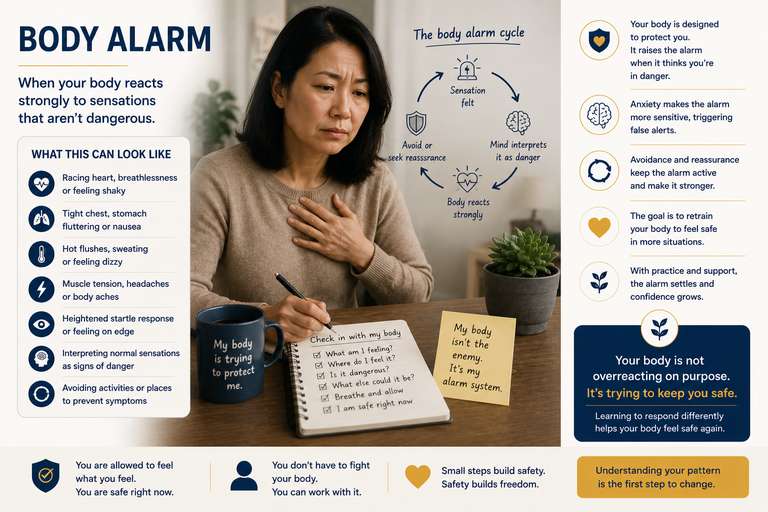
This pattern may show up as panic attacks, fear of bodily sensations, fear of fainting, fear of being sick, health-related worry, or avoiding places where escape would feel difficult.
A useful starting point is often rebuilding trust in the body. This does not mean ignoring genuine medical concerns. It means helping the nervous system learn that sensations can rise, change and settle without needing constant checking, control or escape.
Control equals safety
Control equals safety means anxiety increases when you cannot control the plan, timing, route, exits, people, food, drink, journey, seating, delay, or what happens next.
Control may have become your way of feeling safe. That is understandable. If anxiety has caught you out before, the mind naturally tries to prevent that happening again. It plans more carefully, checks more often, avoids uncertainty, and tries to make everything predictable.
The difficulty is that anxiety-driven control can slowly teach the nervous system that uncertainty itself is dangerous. At first, you may only need a little planning. Over time, you may need more conditions to be right before something feels possible.
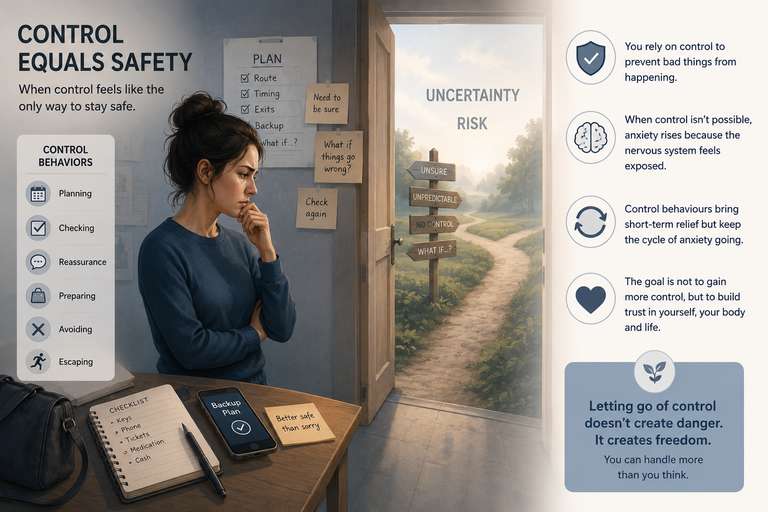
This pattern may show up as needing detailed plans, struggling with sudden changes, avoiding situations where you cannot leave easily, needing to know exactly what will happen, or feeling unsettled when someone else is in charge.
A useful starting point is often loosening the link between control and safety. The aim is not to become careless or unprepared. It is to rebuild confidence that you can cope with ordinary uncertainty without needing every detail locked down first.
Distance from safety
Distance from safety means anxiety rises when you feel too far from home, help, familiar places, trusted people, your car, known routes, safe exits, or an easy way back.
The problem may not be the journey or location itself. It may be the feeling of being beyond your safe zone.
This pattern can make life shrink gradually. At first, one journey may feel difficult. Then certain roads, trains, buses, motorways, unfamiliar places or longer distances start to feel risky. You may still be able to do things close to home, but feel much less confident as the distance increases.
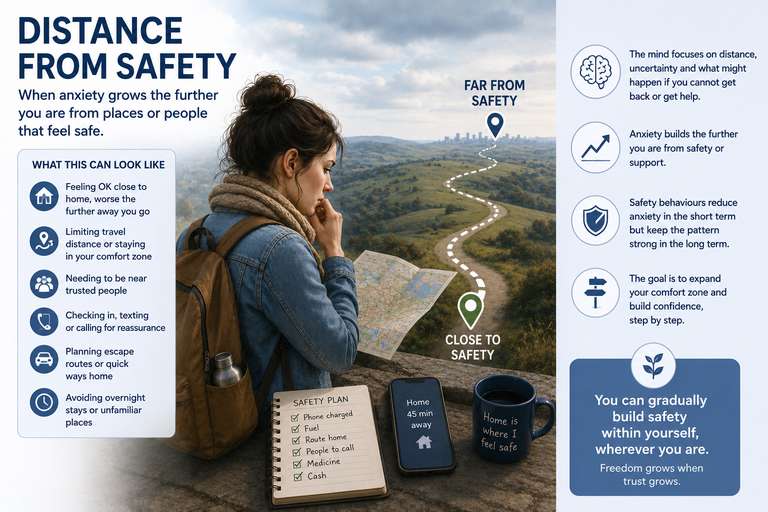
Often, the nervous system starts using distance as a danger signal. The further away you are, the less safe you feel. This can lead to route checking, travelling only with certain people, keeping journeys short, avoiding public transport, or making sure you can get home quickly.
A useful starting point is often rebuilding confidence step by step, so safety becomes less tied to one place. The deeper aim is not simply to travel further. It is to help the nervous system learn that you can carry a sense of safety with you.
Judgement and exposure
Judgement and exposure means anxiety is organised around being seen, judged, embarrassed, criticised, exposed, watched, or unable to hide signs of anxiety.
This pattern is not always about other people in a simple way. It is often about visibility. Being noticed can feel risky when you do not feel fully in control of yourself. You may worry that people will see you blush, shake, sweat, panic, stumble over words, leave suddenly, need the toilet, look awkward, or not cope.
The mind may then try to protect you by rehearsing conversations, planning what to say, avoiding attention, staying quiet, hiding symptoms, choosing safe seats, leaving early, or replaying the situation afterwards to check whether you seemed okay.
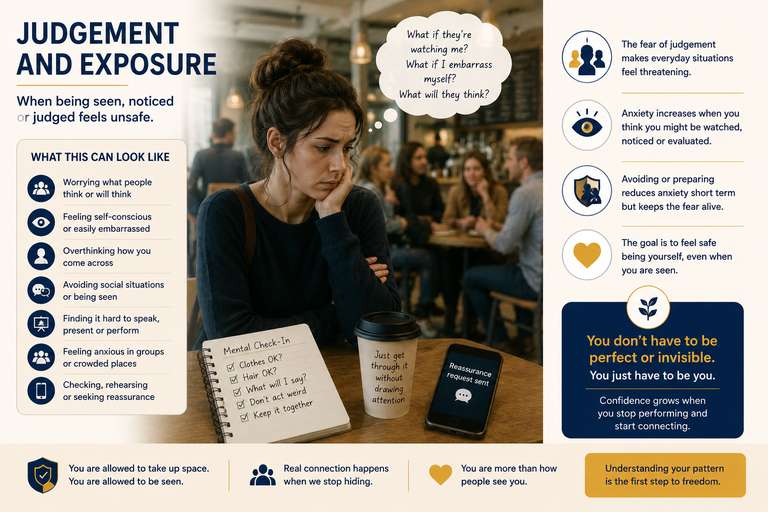
This pattern may show up as social anxiety, fear of embarrassment, anxiety in meetings, avoiding meals out, worrying what people think, or feeling trapped when attention is on you.
A useful starting point is often reducing the need to hide anxiety. That does not mean throwing yourself into terrifying social situations. It means helping the nervous system learn that being visible is not the same as being unsafe.
Access and body trust
Access and body trust means anxiety is organised around toilet access, timing, urgency, delays, queues, blocked access, awkward access, privacy, unfamiliar places, travel, or the fear of not getting to a toilet in time.
This pattern is not usually about being afraid of toilets themselves. It is more often about whether you can trust your body when access is uncertain.
The fear may be triggered by traffic, meetings, trains, buses, queues, restaurants, social events, long journeys, unfamiliar buildings, appointments, or any situation where getting to a toilet quickly might not feel simple.
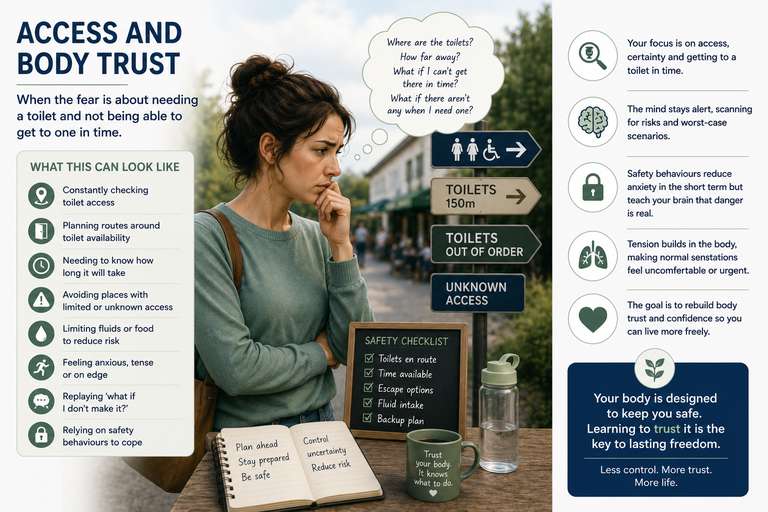
To feel safer, you may check where toilets are, plan routes, avoid certain journeys, restrict food or drink, try to make sure your bladder or bowel feels empty, stay near exits, sit in particular places, avoid queues, leave early, or only go to familiar places.
These behaviours make sense in the short term because they reduce uncertainty. But they can also keep the nervous system focused on risk.
Over time, the anxiety can become less about what is actually happening in the body and more about the question, “What if I need to go and cannot get there?” The body starts to feel unreliable, even when there may have been little or no real evidence that it will fail you.
A useful starting point is often rebuilding body trust. That usually means moving away from more checking, more planning and more restriction, and towards helping the nervous system learn that the body can be trusted even when access is not perfectly controlled.
The thinking loop
The thinking loop means anxiety is being kept active by repeated anxious thinking.
This can include “what if” thoughts before something happens, mentally rehearsing how things could go wrong, replaying events afterwards, analysing conversations, checking decisions, trying to understand every feeling, or trying to think your way to certainty.
The “what if” loop is one part of this pattern, but it is not the whole thing. What-if thoughts are usually future-focused. They look ahead and imagine possible problems. For example, “What if I panic?”, “What if I need the toilet?”, “What if I cannot leave?”, “What if I embarrass myself?”, or “What if I do not cope?”
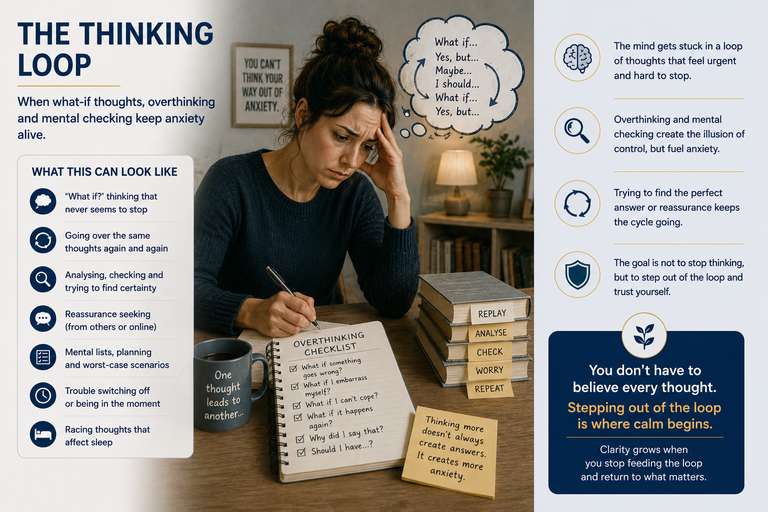
Other thinking loops may be more focused on the past or on decisions. You may replay what happened, question whether you said the wrong thing, analyse why you felt anxious, or keep trying to work out the perfect solution.
This kind of thinking can feel useful because it seems like preparation or problem-solving. But often it does not lead to resolution. Instead, it keeps the nervous system switched on, as though the problem is still happening or still needs to be solved.
A useful starting point is often learning how to disengage from the loop. That does not mean forcing a blank mind or suppressing thoughts. It means noticing when the mind is pulling you into anxious thinking and gradually reducing the habit of treating every thought as something that must be followed, solved or checked.
Performance pressure
Performance pressure means anxiety is organised around getting it right, freezing, failing, disappointing people, being judged on the outcome, or not being able to perform when it matters.
This can appear in work, study, public speaking, interviews, exams, sport, creative work, meetings, social roles, or any situation where the outcome feels important.
The common thread is that the situation starts to feel like a test.
The pressure may create a loop. You want to do well, so you monitor yourself more closely.
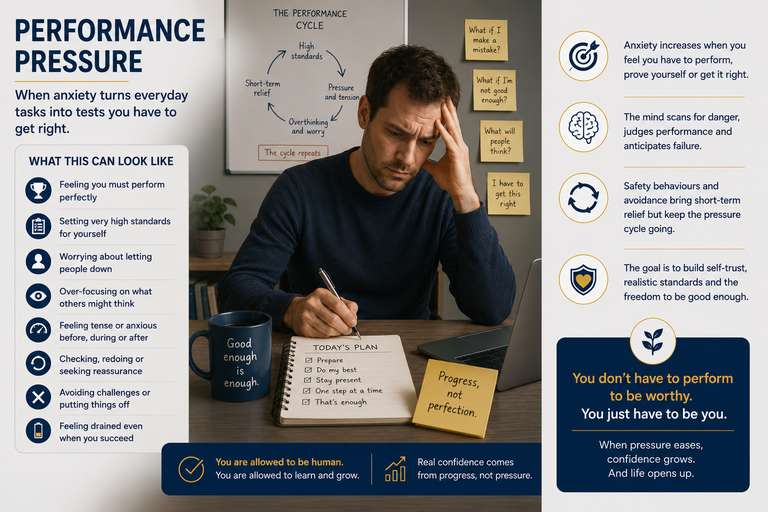
The more you monitor yourself, the more self-conscious you become. The more self-conscious you become, the harder it is to perform naturally. Then the anxiety seems to confirm the fear that you might freeze, fail, stumble, blush, shake, forget something or let people down.
This pattern may show up as presentation anxiety, exam nerves, interview anxiety, fear of speaking up, fear of freezing, avoidance of opportunities, or feeling unable to perform when it matters.
A useful starting point is often changing the relationship with pressure. The aim is not to stop caring or to lower your standards. It is to help the nervous system stop treating performance as a threat to safety, identity or worth.
Mixed anxiety pattern
A mixed anxiety pattern means your answers suggest several overlapping patterns rather than one clear main pattern.
This is common. Anxiety often does not stay neatly in one box. Someone may have body alarm, distance from safety and control-based anxiety at the same time. Another person may have toilet access fears, judgement and exposure, and the thinking loop all feeding into each other.
A mixed result does not mean the anxiety is impossible to understand. It usually means we need to look at the strongest safety loops.
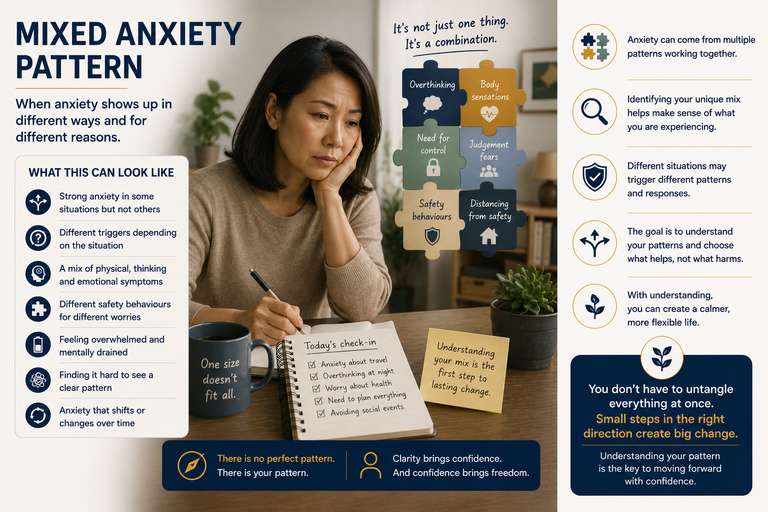
For example, if avoidance, checking, reassurance, planning, body scanning or mental rehearsal are keeping the anxiety active, those loops give us a practical place to begin.
The useful question is not always, “Which single type of anxiety do I have?” It may be, “Which part of the loop is keeping this going?”
Safety Behaviours And Anxiety Loops
The Anxiety Pattern Finder also looks at safety behaviours.
Safety behaviours are the things you do to feel safer when anxiety appears. They are not stupid or irrational. Most of the time, they develop because, at some point, they seemed to help.
The problem is that safety behaviours can gradually become part of the anxiety loop. Avoidance may teach the nervous system that staying away is what kept you safe. Checking can keep attention fixed on possible danger. Reassurance can make certainty feel necessary before you move forward.
Planning and control can also make unplanned moments feel more threatening, while escape preparation can teach the nervous system that the exit is the source of safety. Body scanning can make normal sensations feel more important, and restriction or control rituals can make ordinary flexibility feel risky.
Mental rehearsal and rumination can have the same effect. They may feel like preparation or problem-solving, but they can keep the mind responding to a threat that is not actually happening now.
This is why two people with similar symptoms may need different starting points. The pattern matters. The safety loop matters too.
Why This Is Not A Label
Your anxiety pattern is not your identity.
It is not a fixed personality type, and it does not mean you are broken. It is simply a way of understanding what your nervous system has learned to treat as unsafe, and what you may be doing to feel safer.
That matters because patterns can change.
When you understand the pattern, you can begin to work with the right part of the loop. For one person, that may mean rebuilding trust in the body. For another, it may mean reducing reassurance. For another, it may mean loosening the need for control, rebuilding confidence away from home, or learning to disengage from anxious thinking.
The aim is not to force yourself through anxiety or remove every coping strategy overnight. The aim is to understand the loop clearly enough that change becomes possible.
What To Do Next
If you have completed the Anxiety Pattern Finder, your report will show which patterns appeared most strongly in your answers.
Read it as a starting point, not a diagnosis.
You may recognise one pattern very clearly. Or you may see several patterns interacting. Either way, the result can help you understand what your anxiety is trying to protect you from, and what may be keeping it active.
If the result feels familiar and anxiety is affecting your life, you may find it helpful to talk it through with someone who understands how these patterns work.
The Surrey Institute of Clinical Hypnotherapy works with anxiety by looking at the pattern underneath the symptoms, the safety behaviours that keep the loop active, and the changes needed to help the nervous system feel safe again.