
Overthinking and anxiety often become so tangled together that it can be difficult to know where one ends and the other begins.
For many people, anxiety is not only experienced as a feeling in the body. It is also experienced as a stream of thoughts. Questions. Warnings. Predictions. Mental rehearsals. The mind starts checking one thing, then another, then another. It looks for the missing piece of information that might finally make everything feel safe.
But of course, it rarely ends there.

The more the person thinks, the more urgent the problem can start to feel. The more they analyse, the less certain they often become. The more they try to prepare for every possible outcome, the more anxiety seems to spread into ordinary life.
This is one of the reasons overthinking and anxiety can be so exhausting. The mind appears to be helping, but in many cases it is also keeping the alarm switched on.
At The Surrey Institute of Clinical Hypnotherapy, we often see this pattern in people struggling with anxiety, toilet anxiety, panic, social anxiety, health anxiety, driving fears, confidence problems and many other difficulties. Overthinking can also be very common in people with ADHD and ADD, where a busy attention system may make it harder to switch off, settle, or step away from a thought once it has taken hold.
Overthinking is not a character flaw. It is not weakness. It is not stupidity. Usually, it is the mind trying to protect you.
The problem is that the protection system has become too active.
Overthinking Is Not Just Thinking Too Much
When people talk about overthinking, they often make it sound simple. As if it is just too many thoughts. As if the person should be able to distract themselves, calm down, or tell themselves to stop being silly.
That misses the point.
Overthinking and anxiety are usually driven by a search for certainty. The mind wants to know what will happen, how you will cope, what other people will think, whether a symptom matters, whether you are safe, whether you have prepared enough, whether you have missed something important.
And sometimes, of course, thinking is useful. We all need to plan, reflect and make sensible decisions. It would be strange not to.
The difficulty begins when thinking stops being practical and becomes repetitive. The same question comes back again and again, but no answer feels strong enough to settle it. The person may get a little relief for a moment, but then the doubt returns.
That is when overthinking stops being problem-solving and starts becoming anxiety disguised as problem-solving.
How Overthinking Fuels Anxiety
The reason how overthinking fuels anxiety matters so much is that thinking does not happen in isolation. It affects the body.
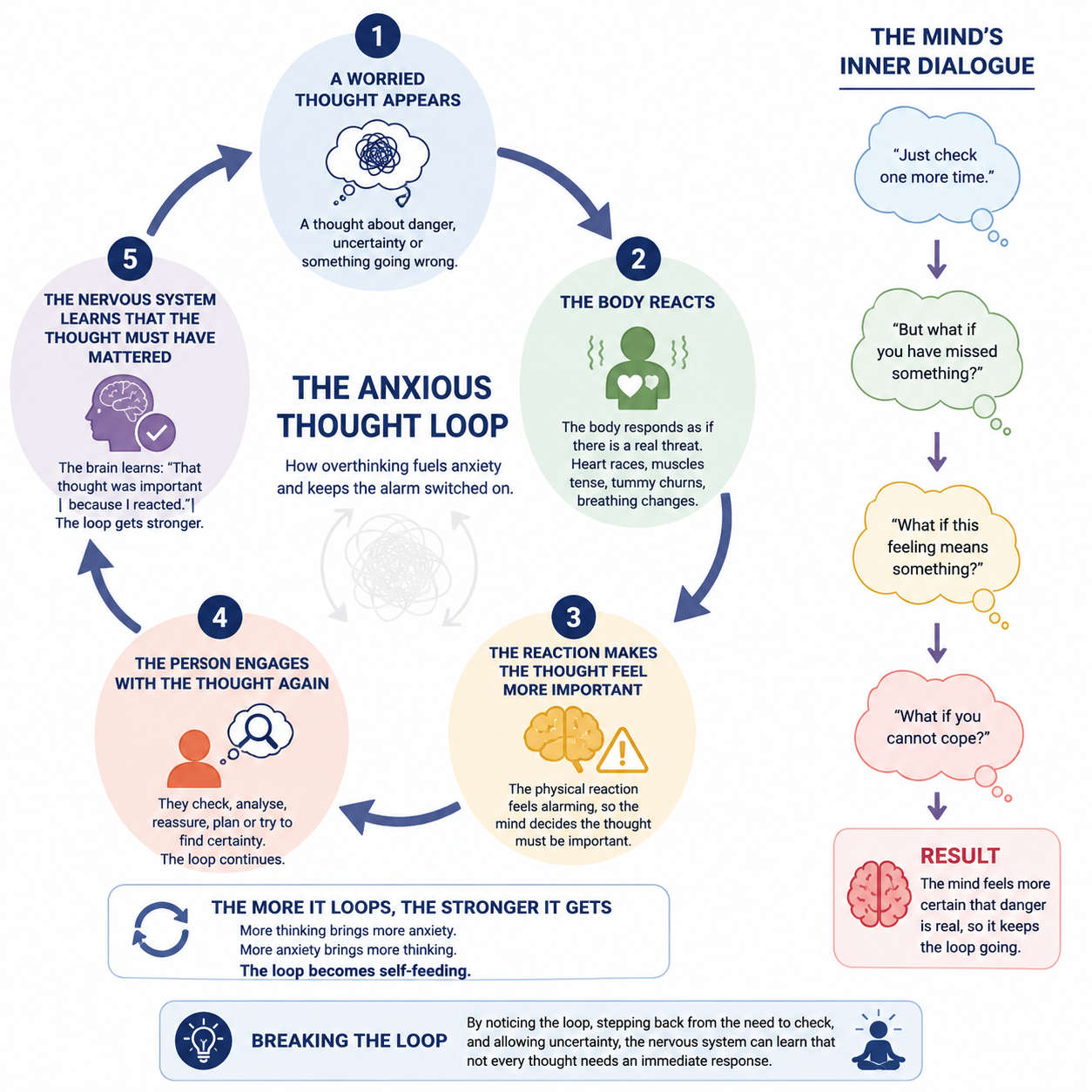
Each round of thinking can make the subject feel more threatening. The body may tighten. The stomach may churn. The chest may feel heavier. The person may become more alert, more watchful, more desperate to find an answer.
Then that physical reaction seems to confirm the fear.
So the mind thinks even more.
This is one of the hidden traps of overthinking anxiety. The person believes they are trying to reduce anxiety, but the process of repeated checking, analysing and rehearsing can become one of the things that keeps anxiety active.
Why The Mind Wants Certainty
An anxious mind often wants certainty before it allows you to act.
- It wants to know you definitely will not panic.
- It wants to know you definitely will not be embarrassed.
- It wants to know you definitely will not lose control. It wants to know you definitely will not make the wrong decision.
- It wants to know you definitely will not feel trapped, judged, overwhelmed, unwell, or unable to cope.
The problem is that real life does not offer that kind of certainty. Not completely. So the person becomes stuck waiting for a level of safety that cannot be guaranteed.
This does not mean anxiety is irrational nonsense. That would be too dismissive. Many anxious thoughts contain a grain of truth. A journey might be uncomfortable. Someone might judge you. A symptom might need attention. A meeting might be difficult. A conversation might not go perfectly.
But anxiety takes possibility and treats it like probability. Then overthinking takes probability and tries to treat it like certainty.
That is an impossible job.
Try the free anxiety pattern finder
Anxiety can be kept active by different patterns, including body alarm, overthinking, control, distance from safety, judgement, performance pressure or access and body trust.
The free Anxiety Pattern Finder can help you identify your main anxiety pattern and the safety behaviours that may be keeping it going.
Use the free Anxiety Pattern FinderToilet Anxiety And The Overthinking Loop
Toilet anxiety is one of the clearest examples of how overthinking and anxiety can take over ordinary life.
Many people misunderstand toilet anxiety. They assume it means being afraid of toilets, germs, embarrassment, or using a toilet in public. Sometimes those issues may be present, but for many people the real fear is different.
It is the fear of needing a toilet and not being able to get to one in time.
Once that fear becomes active, overthinking can spread into almost everything. Before a journey, the person may think about toilet access, journey time, traffic, whether they should eat, whether they should drink, whether they should go to the toilet again before leaving, whether they will be trapped, whether they will panic, whether they could cope if the feeling suddenly appears.
A simple journey becomes a mental operation.
There may be route checking. Toilet checking. Body checking. Food checking. Reassurance seeking. Escape planning. The person may feel as if they are being sensible and prepared, and in one sense they are. But the nervous system may be learning a very different lesson.
It may be learning, “This situation must be dangerous because we keep preparing for disaster.”
This is why toilet anxiety can become so limiting. It is not only the fear of what might happen. It is the constant mental work around what might happen.
You can read more about this specific pattern on our page about hypnotherapy for toilet anxiety.
The Same Pattern Appears In Many Types Of Anxiety
Although toilet anxiety is a clear example, the same mechanism appears in many other anxiety problems.
Someone with health anxiety may monitor every sensation and repeatedly wonder whether it means something serious.
Someone with social anxiety may replay conversations, searching for signs that they sounded awkward, foolish, boring, or unlikeable.
Someone with panic anxiety may constantly scan the body, checking breathing, heart rate, dizziness, tightness, temperature, or any slight change in sensation.
Someone with relationship anxiety may analyse a message, a pause, a tone of voice, or a slight change in behaviour.
Someone with work anxiety may rehearse every possible criticism before a meeting has even happened.
Someone with sleep anxiety may spend the evening worrying about whether they will sleep, which makes sleep feel even more pressured.
The subject changes, but the loop is often similar. The mind wants certainty. The nervous system wants safety. The person gets caught in the middle.
This is why anxiety can feel so invasive. It does not always stay neatly in one place. It can begin with one fear, then gradually appear in other areas of life until the person starts to feel as if they cannot trust their own mind.
If anxiety has started to affect your day-to-day life, you may find it helpful to read more about how we work with anxiety through hypnotherapy for anxiety.
Overthinking, ADHD And ADD
Overthinking is also very common in people with ADHD and ADD. This needs to be said carefully, because ADHD is not simply anxiety. ADD is not just worrying too much. And not every person with ADHD experiences overthinking in the same way.
But many people with ADHD or ADD describe having a mind that does not easily switch off. Thoughts can arrive quickly. Attention can jump from one subject to another. Unfinished tasks can linger in the background. Emotional reactions may feel intense. Decision-making can become tiring because every possible option seems to open another set of consequences.
A person with ADHD may overthink because their mind is trying to hold too much at once.
They may replay what they said. They may worry they have forgotten something. They may become stuck between choices. They may struggle to let go of an unresolved thought. They may find that a small uncertainty quickly becomes mentally loud.
This can make overthinking and anxiety harder to separate.
Sometimes the person is anxious because they are overthinking. Sometimes they are overthinking because their attention system is overloaded. Sometimes both are happening together.
That is why telling someone to “just stop thinking about it” is rarely helpful. It can even add shame to a system that is already working too hard.
If ADHD or ADD feels relevant to your own pattern, you can read more about hypnotherapy for ADHD.
The False Urgency Loop
One of the most useful ways to understand overthinking and anxiety is to think of it as a false urgency loop.
- A thought appears.
- The body reacts.
- The reaction makes the thought feel important.
- The person engages with the thought.
- The engagement teaches the brain that the thought deserved attention.
- Then the thought comes back stronger next time.
This can be incredibly convincing. It can feel as if the thought is urgent because the body feels urgent. But the feeling of urgency does not always mean there is a real emergency. Sometimes it means the nervous system has learned to respond quickly to a familiar trigger.
This is especially true when the same fears have been rehearsed many times.
The more often the mind checks a subject, the more important that subject can feel. The more important it feels, the more the body reacts. The more the body reacts, the more the mind believes it must keep checking.
It becomes self-feeding.
This is why trying to think your way out of anxiety can backfire. It may feel responsible. It may feel careful. It may even feel necessary. But if the thinking is repetitive, urgent and fear-led, it may be reinforcing the very pattern you want to change.
Why Reassurance Does Not Always Work
Many people who struggle with overthinking and anxiety seek reassurance.
They ask someone else if things will be okay. They search online. They check symptoms. They look up routes. They review messages. They replay events. They try to find proof that the feared thing will not happen.
Reassurance can help for a moment. Sometimes it is appropriate and necessary. If there is a genuine medical concern, practical risk, or important decision, checking can be sensible.
But with anxiety, reassurance often has a short shelf life.
The mind accepts the answer briefly, then finds a new angle.
- “What if they were just being kind?”
- “What if I missed something?”
- “What if this time is different?”
- “What if I felt okay then, but not later?”
This is why reassurance can become addictive. Not in a moral sense, but in a nervous system sense. The person feels uncomfortable, seeks reassurance, feels better briefly, then needs more reassurance when the doubt returns.
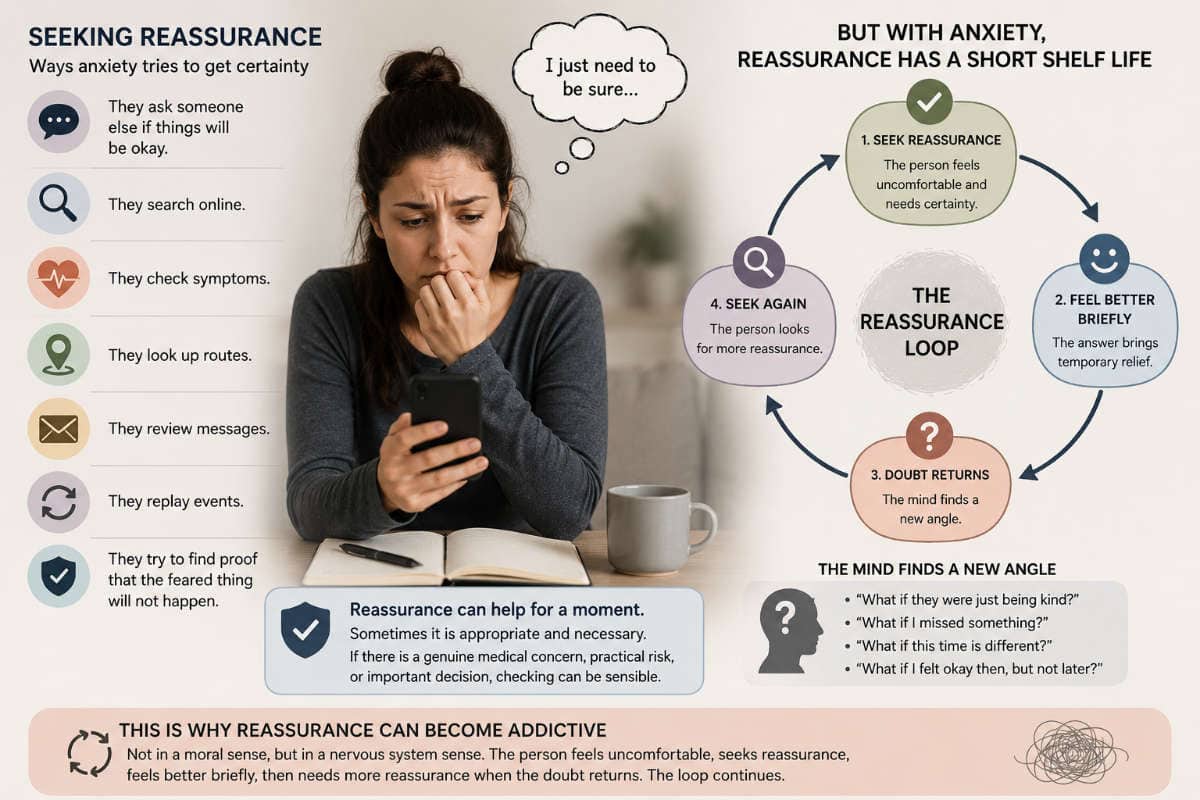
Over time, the brain may learn that uncertainty must be solved immediately.
Hypnotherapy can be helpful here because the work is not only about answering the thought. It is about changing the response to the thought. That distinction matters.
Recovery Is Not About Emptying The Mind
Recovery from overthinking and anxiety is not about having no thoughts.
That would be unrealistic. It would also be the wrong target. The mind thinks. That is what minds do. The aim is not to win every argument with every anxious prediction. The anxious mind can always produce another “what if”. If you answer one, it may simply create a new one.
The work is more about changing your relationship with thoughts.
You begin to notice when the mind has moved from useful planning into repetitive looping. You start recognising urgency without automatically obeying it. You become more able to allow some uncertainty to exist without rushing to neutralise it.
That is not the same as ignoring real problems. It is not pretending everything is fine. It is learning to respond more proportionately.
For many people, this means helping the nervous system relearn safety. The mind can only do so much if the body is still reacting as though danger is close. This is why hypnotherapy often works with both thought patterns and physical responses. It can help the person begin to respond differently at a deeper level, not just argue with themselves on the surface.
How Hypnotherapy Can Help With Overthinking And Anxiety
At The Surrey Institute of Clinical Hypnotherapy, we do not see hypnotherapy as simply closing your eyes and relaxing. That may be part of the work, but it is not the whole of it.
Hypnotherapy can involve insight, therapeutic conversation, reframing, metaphor, waking suggestions, subconscious rehearsal, emotional regulation and carefully structured change work. The aim is to help the mind and body stop responding as if every anxious thought is an instruction, a warning, or an emergency.
For someone with overthinking and anxiety, this may mean working on the urge to check, the need for certainty, the fear of losing control, the body’s automatic alarm response, or the belief that thinking harder will somehow create safety.
In toilet anxiety, it may involve rebuilding trust in the body and reducing the constant need to calculate toilet access.
In general anxiety, it may involve changing how the person responds to uncertainty.
In ADHD or ADD, where appropriate, it may involve helping the person create calmer internal responses and reduce the emotional charge around looping thoughts, while still respecting the reality of attention differences.
Good hypnotherapy should not shame the person for overthinking. It should help them understand why the pattern developed, then begin changing it in a way that feels realistic.
Stop Overthinking Anxiety By Changing The Pattern
The phrase stop overthinking anxiety can sound too simple, as if stopping is just a matter of willpower.
Most people have already tried that.
They have tried distracting themselves. They have tried telling themselves not to worry. They have tried being logical. They have tried reassurance. They have tried pushing the thoughts away.
The better question is not, “How do I force these thoughts to stop?” It is, “How do I stop training my brain to treat these thoughts as urgent?” That is a more useful starting point.
It means noticing when the mind is looping rather than solving. It means stepping back before the tenth round of checking. It means learning that discomfort is not always danger. It means allowing the body to settle without needing to solve every possible outcome first.
It also means understanding that anxiety often improves when the person stops treating every uncertain thought as a crisis.
That can take practice. It can take support. But it is possible.
Overthinking Does Not Have To Run Your Life
Overthinking and anxiety can make life smaller without you noticing at first.
You avoid one situation. Then another. You need more preparation. You become more dependent on checking, planning, escape routes, reassurance, research, reviews, routines and backup plans. From the outside, you may still look capable. Inside, you may feel mentally exhausted.
But overthinking is not who you are.
It is a pattern. A powerful pattern, yes. A convincing one. Sometimes a long-standing one. But still a pattern.
And patterns can change. When the mind learns that it does not have to answer every anxious question, the body can begin to feel less threatened. When the body feels less threatened, the mind has less urgency to feed on. Slowly, the loop can weaken.
That does not mean life becomes perfectly certain. It never was.
But it can become bigger again. Quieter again. More flexible again.
If overthinking and anxiety are affecting your life, hypnotherapy can help you change the way your mind and body respond to uncertainty, urgency and imagined threat.
Next Steps
If overthinking has become part of your anxiety pattern, hypnotherapy can help you change the way your mind and body respond to uncertainty, urgency and imagined threat.
You can start by reading more about hypnotherapy for anxiety.
Or, if your anxiety is specifically connected to fear of needing the toilet and not reaching one in time, visit our page about hypnotherapy for toilet anxiety.