
If you feel anxious about being away from the toilet, the problem is rarely just about the toilet itself.
In my clinical experience, toilet anxiety is usually linked to the fear of needing the toilet and not being able to get to one in time. The anxiety often increases when toilet access feels uncertain, difficult, delayed, awkward or impossible. That might happen in a meeting, on a motorway, on a train, in a restaurant, in a queue, or simply when you are away from home.
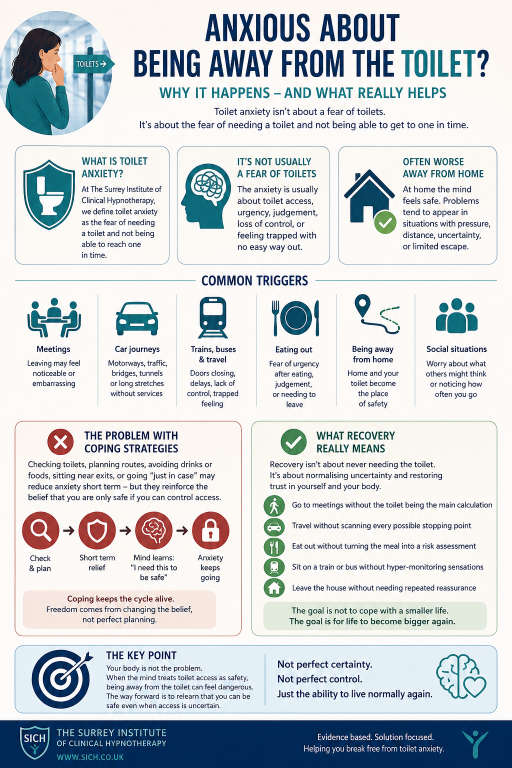
At The Surrey Institute of Clinical Hypnotherapy, we define toilet anxiety as the fear of needing a toilet and not being able to reach one in time. That distinction matters. This is not usually a fear of toilets. It is more often anxiety about toilet access, urgency, embarrassment, judgement, loss of control, or being trapped with no easy way out.
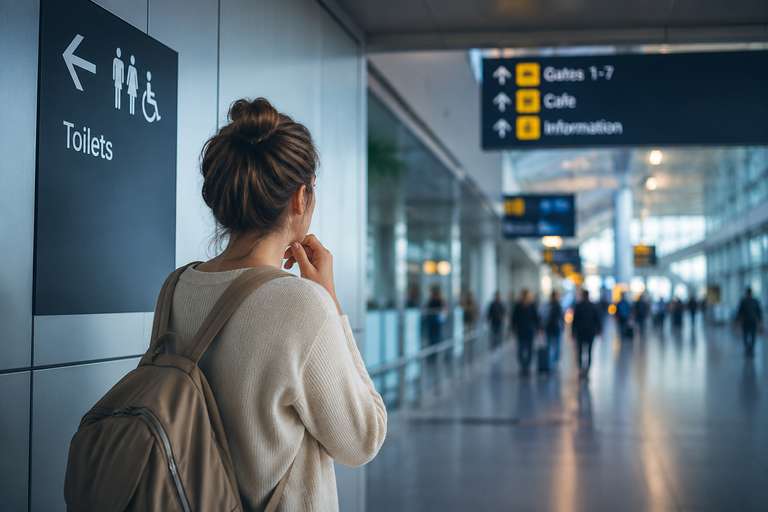
Once that link is made, the mind starts to treat toilet access as something essential. Not preferable. Not convenient. Essential. The person may feel they need to know where the toilet is, need to go before leaving, need to sit near an exit, need to avoid certain journeys, or need to restrict food and drink. These behaviours can feel sensible in the moment, but clinically they often become part of the problem.
They do not just reduce anxiety. They can also teach the mind that the anxiety was justified.
Why toilet anxiety is usually about access and safety
One of the common misunderstandings about toilet anxiety is that people assume it must be a fear of toilets. For most of the clients I see, that is not the case.
The anxiety is usually about being away from the toilet when they believe they might need one. That word “away” is important. The fear tends to increase when access becomes uncertain or complicated.
For example, someone may be fine if they are at home and can use the toilet whenever they want. But if they are in a meeting and leaving would be noticeable, the situation feels different. If they are in a car on a motorway with no service station nearby, the situation feels different. If they are on a train that might stop between stations, the situation feels different. If they are eating out with people they do not know well, the situation feels different again.
The body may not have changed very much, but the context has.
This is why toilet anxiety is often closely connected to feeling trapped. The person may not be physically trapped in the strictest sense, but they feel restricted. They feel watched. They feel there may be consequences if they have to leave, or if they need to go more than once, or if someone notices.
That is where judgement becomes part of the fear.
A person may worry, “What if people think I am strange?” or “What if they notice I keep going to the toilet?” or “What if I have to leave the room and everyone looks at me?” Over time, the fear is no longer only about getting to the toilet in time. It is also about what needing the toilet might mean socially.
That is a powerful combination, urgency, trapped feeling and fear of judgement.
Why it feels worse when you are away from home
One of the questions I often ask clients is this:
Does the problem happen when you are at home, relaxed, alone, with nothing going on and no pressure to go anywhere?
If the answer is no, that tells us something important.
It does not mean the sensations are fake. It does not mean the person is making it up. It also does not mean medical issues should be ignored. New, severe, persistent, or unexplained bowel or bladder symptoms should always be checked properly by a medical professional.
But clinically, if the problem mainly appears in situations involving pressure, distance, uncertainty, judgement, or difficulty escaping, then we are usually looking at the threat system, not just the digestive or bladder system.
At home, the mind often feels safe. There is no meeting to sit through. No train doors closing. No motorway stretch with no services. No queue. No audience. No social embarrassment. No need to explain yourself.
So the nervous system settles.
When the same person moves into a situation where toilet access feels uncertain, the mind may start scanning. “Where is the toilet?” “Could I leave?” “What if I need to go?” “What if I cannot get there?” “What if people notice?”
That scanning is not neutral. It increases the sense of threat.
And once the threat system switches on, the body can respond.
Why the urgency feels so real
This is one of the most important parts of toilet anxiety to understand. The urgency can feel completely real because, in many cases, the body is genuinely involved.
Urgency may be a genuine body sensation. It may be anxiety amplifying normal sensations. It may be a learned response to certain situations. Often, it is a mixture of all three.
That is why telling yourself “there is nothing wrong” does not always work. The sensation may still be there. The stomach may still tighten. The bladder may still feel more noticeable. The bowel may still feel active. The body may still seem to be sending warning signals.
But the key question is not only, “Can I feel something?”
The better question is, “What is my mind doing with that sensation?”
A normal sensation can become alarming when the mind treats it as evidence of danger. A mild urge can become urgent when the person starts checking it. A passing sensation can become the centre of attention when the nervous system is already on alert.
This is why toilet anxiety can feel so convincing. The person is not simply worrying in an abstract way. They are often feeling real sensations, but those sensations are being interpreted through a threat-based lens.
The mind has learned to connect the sensation with danger.
Anxiety about toilet access and feeling trapped
I see this pattern in many different situations.
Some clients struggle with car journeys. The fear may increase on motorways, country roads, traffic jams, bridges, tunnels, or anywhere they believe stopping would be difficult. The fear is not always that they need the toilet now. It may be the fear that they might need it and not be able to get to one.
Other clients struggle with meetings. This can be especially difficult because leaving the room may feel noticeable. The person may worry that people will judge them if they go more than once, or if they appear restless, anxious or distracted.
Some struggle with trains, buses, trams or underground travel. The issue may be the doors closing, the lack of control, the possibility of delays, or the feeling of being unable to escape if the urge appears. These patterns are also common in toilet anxiety when travelling, where distance, uncertainty and access become central to the fear.
Eating out is another common trigger. The person may worry that food will cause an urgent need to go, even when the timing does not make much sense physiologically. They may become hyperaware of stomach sensations. They may avoid meals before going out, choose “safe” foods, or sit in a position where they can leave quickly.
Others struggle with being away from home generally. Home becomes the place of safety. The toilet at home becomes part of that safety. The further they travel from home, the more exposed they feel.
In each of these examples, the details may look different, but the underlying pattern is similar.
The mind has started treating toilet access as safety.
The problem with coping strategies
Most people with toilet anxiety do not sit around doing nothing about it. They usually work very hard to manage it.
They check where toilets are before they go out. They plan routes around service stations. They sit near exits. They avoid the middle seat. They go to the toilet “just in case”. They avoid drinking too much. They avoid certain foods. They leave extra time. They avoid trains, buses, motorways, meetings, restaurants, theatres, long walks, unfamiliar places, or anywhere that feels difficult to escape from.
Understandably, they are trying to feel safe.
But this is where the problem becomes more complicated.
In my view, coping strategies and avoidance behaviours are often the enemy of recovery, because they help maintain and validate the problem. They may reduce anxiety in the short term, but they can also teach the mind that the situation was only safe because the coping strategy was used.
So if someone gets through a journey because they checked every toilet on the route, the mind may conclude, “Good job we checked.”
If they get through a meeting because they sat near the door, the mind may conclude, “Good job we had an escape route.”
If they leave the house only after going to the toilet several times, the mind may conclude, “Good job we made sure.”
The person feels relief, but the belief is reinforced.
That belief is usually something like, “I am only safe if I can control toilet access.”
This is why standard advice can sometimes miss the point. Advice that focuses mainly on planning, checking, reassurance or avoidance may sound helpful, but it can accidentally strengthen the anxiety pattern. It keeps the person organising life around toilet access, rather than changing the relationship between toilet access and safety.
In our clinical observations on toilet anxiety, coping strategies and avoidance behaviours are extremely common. That matters because they are not just habits. They can become part of the system that keeps the anxiety active.
Why “I need to know where the toilet is” can be misleading
Many people with toilet anxiety say, “I just need to know where the toilet is.”
I understand why it feels that way. When the anxiety is high, knowing where the toilet is can feel essential.
But clinically, I would challenge the wording.
You do not always need to know. You believe you need to know. There is a big difference.
That difference matters because the belief can become the problem. The more the person obeys the belief, the more powerful it becomes. The mind starts to behave as though toilet access must be confirmed before life can continue.
Of course, knowing where a toilet is can be useful. Everyone prefers convenience. Nobody wants to be uncomfortable. But toilet anxiety turns preference into necessity. It takes something ordinary and makes it feel like a condition of safety.
That is the shift we need to understand.
The problem is not wanting a toilet nearby. The problem is feeling unable to be okay unless one is nearby.
What recovery from toilet anxiety really means
Recovery from toilet anxiety is not about becoming someone who never needs the toilet. That would be unrealistic, and it is not the point.
It is also not about forcing yourself to be uncomfortable or pretending the fear does not exist.
In my experience, meaningful recovery is much simpler to describe, although not always simple to achieve. It is when it becomes normal not to think about the toilet.
That may sound almost too ordinary, but that is exactly why it matters.
The person goes to a meeting and the toilet is not the main calculation. They travel in a car and do not mentally scan every possible stopping point. They eat out without turning the meal into a risk assessment. They sit on a train without monitoring every sensation. They leave the house without needing repeated reassurance from their own body.
The toilet goes back to being a normal part of life, rather than the thing life is organised around.
This is why toilet anxiety recovery is not just about coping better with the fear. In my opinion, coping is often too small an aim. If someone is still building their life around toilet access, but doing it slightly more efficiently, that may be management, but it is not the same as freedom.
The goal is not to cope better with a smaller life.
The aim is for life to become bigger again.
The key point
The problem is not that your body cannot be trusted.
The problem is that your mind has started treating toilet access as safety.
Once that has happened, being away from the toilet can feel dangerous, even when there is no immediate danger. The urgency can feel real. The fear can feel convincing. The coping behaviours can feel sensible. But that does not mean the belief is accurate.
The way forward is not to keep proving there is always a toilet nearby.
The way forward is to help your system relearn that you can be safe even when toilet access is uncertain.
That is the real shift. Not perfect certainty. Not perfect control. Not a life built around escape routes and safety checks.
Just the ability to live normally again, without the toilet being at the centre of every decision.
Our ongoing clinical toilet anxiety research has found that most people with toilet anxiety have never experienced an adult urinary or bowel accident before developing the condition. This suggests the disorder is often maintained by anticipation rather than previous experience.
Next Steps
If anxiety about being away from the toilet is starting to restrict where you go, how you travel, or what you feel able to do, the next step is to understand the pattern and begin changing the anxiety response behind it.
You can start with our main Hypnotherapy for Toilet Anxiety page, or contact us to talk about how we can help.