
Can toilet anxiety be cured? It’s a question I’ve been asked many times over the years, often by people who have spent a considerable part of their lives worrying about needing a toilet and not being able to reach one. Some have lived with the problem for decades, while others have developed it relatively recently. What they generally have in common is a desire to get back to the life they had before toilet anxiety began influencing almost everything they do.
Recently, I came across a discussion on Reddit that brought this question into particularly sharp focus. Someone had posted in an agoraphobia community describing how their anxiety had become so severe that even a 30-minute journey felt frightening.
They worried constantly about toilet access, avoided unfamiliar places and even became anxious when their partner occupied the only bathroom in their home. Their question was a simple one: had anyone experienced toilet anxiety like this and recovered from it?
What interested me just as much as the original question were the responses. Other people described years, sometimes decades, of similar difficulties. There were suggestions about planning journeys, identifying public toilets, carrying spare clothing, taking medication and practising various techniques to reduce anxiety. There was also a great deal of understanding, which is important because people experiencing toilet anxiety often feel that nobody else understands what they’re going through. But much of the advice was concerned with finding ways to live with the problem rather than considering whether it might be possible to leave it behind.
After more than 20 years working as a clinical hypnotherapist, with toilet anxiety becoming one of my principal areas of specialisation, I’ve come to believe that we sometimes approach this question from the wrong direction. I don’t particularly like the word ‘cure’ when discussing toilet anxiety because it can suggest that we’re trying to eliminate something that’s wrong with the body. In many cases, however, the body is functioning perfectly normally. What has changed is the person’s interpretation of what their body is telling them and their confidence in its ability to do its job.
My objective when working with someone experiencing toilet anxiety isn’t to teach them how to live with it more comfortably. It’s to help them return to normal.
Coping With Toilet Anxiety Is Not the Same as Recovering From It
There is an important difference between coping with toilet anxiety and recovering from it, although the two are frequently confused. Someone might become very accomplished at managing their anxiety by knowing where every public toilet is located, planning journeys around service stations, restricting what they eat or drink and making repeated visits to the bathroom before leaving home. These precautions can provide considerable reassurance, and sometimes they’re sufficient to enable someone to do things they would otherwise avoid.
The difficulty is that their confidence often depends on those precautions remaining available. If the journey changes, a toilet is unexpectedly closed or somebody else occupies the bathroom, the anxiety can return almost immediately. In effect, the person hasn’t necessarily become more confident in their ability to manage an ordinary bodily need. They’ve become more confident in their arrangements for preventing a feared situation.
This is why I regard unnecessary avoidance and safety behaviours as such an important part of toilet anxiety. They may provide relief in the short term, but they can also reinforce the belief that something terrible would happen without them. Over time, people can become increasingly dependent on arrangements that were originally intended to make their lives easier.
Of course, there are circumstances where planning toilet access is perfectly sensible, particularly for someone managing a genuine medical condition. The issue isn’t whether a person occasionally takes precautions. We all do that. It’s whether those precautions have become requirements that determine what they’re willing to do and where they’re prepared to go.
Recovery, as I understand it, means reaching a point where those decisions are no longer being made primarily through fear. Someone goes shopping because they want to buy something, visits friends because they enjoy their company or takes a journey because they have somewhere to be. They aren’t constantly calculating how far they are from the nearest toilet or what might happen if they suddenly need one.
When the Fear Becomes More Convincing Than the Evidence
Something I’ve observed repeatedly in my clinical work is how selectively people experiencing toilet anxiety can interpret their experiences. They may have completed hundreds, perhaps thousands, of journeys without an accident, yet remain convinced that the next journey could end in disaster. Their attention is focused almost entirely on what might happen, while the evidence of what has actually happened receives very little consideration.
I recently worked with someone who described becoming trapped in a lengthy traffic jam on a motorway while needing the toilet. They were unable to leave the motorway, the traffic wasn’t moving and there was no immediate prospect of reaching a service station. As the delay continued, they became increasingly distressed and uncomfortable. Eventually, after approximately 45 minutes, the traffic began moving again and they reached a service station where they could use the toilet.
When we discussed the experience, my client regarded it as a particularly traumatic event. They remembered the distress, the discomfort and the terrible uncertainty about what might happen if the traffic didn’t start moving. From their perspective, the experience appeared to confirm just how vulnerable they were whenever a toilet wasn’t immediately available.
I saw something rather different. Despite everything they had experienced during those 45 minutes, their body had maintained continence until they reached the service station. Their sphincter muscles had done precisely the job they were designed to do. I wasn’t suggesting that the experience had been pleasant or that they should have been able to tolerate the discomfort indefinitely. I was simply drawing attention to an important piece of evidence that had been almost completely overlooked.
We were considering exactly the same event, but interpreting it in two very different ways. My client saw an experience that demonstrated how frightening a delay could become. I saw an experience that also demonstrated their body’s ability to maintain control under difficult circumstances.
That distinction matters because our beliefs are influenced not simply by what happens to us, but by the meaning we attach to those experiences. When someone consistently interprets situations through the expectation of losing control, even events in which they successfully maintain control can become further reasons to be frightened.
This doesn’t mean that accidents never happen, or that everyone can delay using the toilet for as long as they wish. Nobody has that guarantee, and nobody needs it to live normally. Occasional urgency, discomfort and inconvenient circumstances are experiences shared by people throughout the world. The difference is that most people don’t organise their entire lives around preventing them.
Why the Sensation of Urgency Can Become So Frightening
The original Reddit discussion included an example I recognised immediately from my own clinical experience. The person described becoming anxious when their boyfriend entered the only bathroom in their flat, even though they had previously been comfortable.
It’s worth considering what has actually changed in that situation. The boyfriend entering the bathroom hasn’t suddenly increased the amount of urine in the bladder or waste in the bowel. What has changed is the person’s perception of their ability to reach a toilet if they need one. The temporary loss of access is interpreted as a potential threat, and that interpretation can produce a very real anxiety response.
Anxiety affects the body in several ways, including changes in muscle tension, digestive activity and the perception of internal sensations. An ordinary sensation of needing the toilet may consequently begin to feel considerably more intense or urgent. The person notices that increased sensation, interprets it as evidence that they really must use the toilet immediately, and becomes more anxious still. It’s a cycle in which fear and bodily sensations can reinforce one another.
One of the things I help clients understand is that the intensity of a sensation doesn’t necessarily tell us how close someone is to losing control. A person can experience a powerful feeling of urgency without there having been a corresponding increase in the contents of their bladder or bowel.
There is, however, an important distinction between anxiety-related sensations and genuine physical conditions. Some people have IBS, Crohn’s disease, bladder disorders or other medical problems that can cause real urgency and require appropriate medical assessment and treatment. I wouldn’t dismiss those symptoms as anxiety, and neither should anyone else. But having a physical condition doesn’t mean that the anxiety associated with it cannot improve. It’s quite possible to have a genuine medical problem and an additional layer of fear that makes everyday life considerably more restrictive than the physical condition alone might require.
What Returning to Normal Actually Looks Like
One of the questions people frequently ask is whether recovery is possible after they’ve experienced toilet anxiety for many years. There seems to be an assumption that the longer the problem has existed, the more difficult it must be to overcome. My clinical experience suggests that the relationship is rather more complicated.
Just recently, I worked with a 59-year-old client who had experienced toilet anxiety involving both bladder and bowel concerns for more than 30 years. After three sessions, she described herself as approximately 80% back to normal. Yet I’ve also worked with people who’ve experienced toilet anxiety for only a couple of years and have needed considerably longer to reach a similar point.
As a very rough rule of thumb, someone who has experienced toilet anxiety for many years may have developed more established patterns of thinking and behaviour, and there can be more to work through. But the duration of the problem isn’t a reliable prediction of how quickly any particular individual will respond. Two people can describe almost identical symptoms yet have very different experiences, beliefs and circumstances contributing to their anxiety. This is one reason I place so much importance on understanding each client as an individual rather than assuming that a familiar collection of symptoms requires an identical approach.
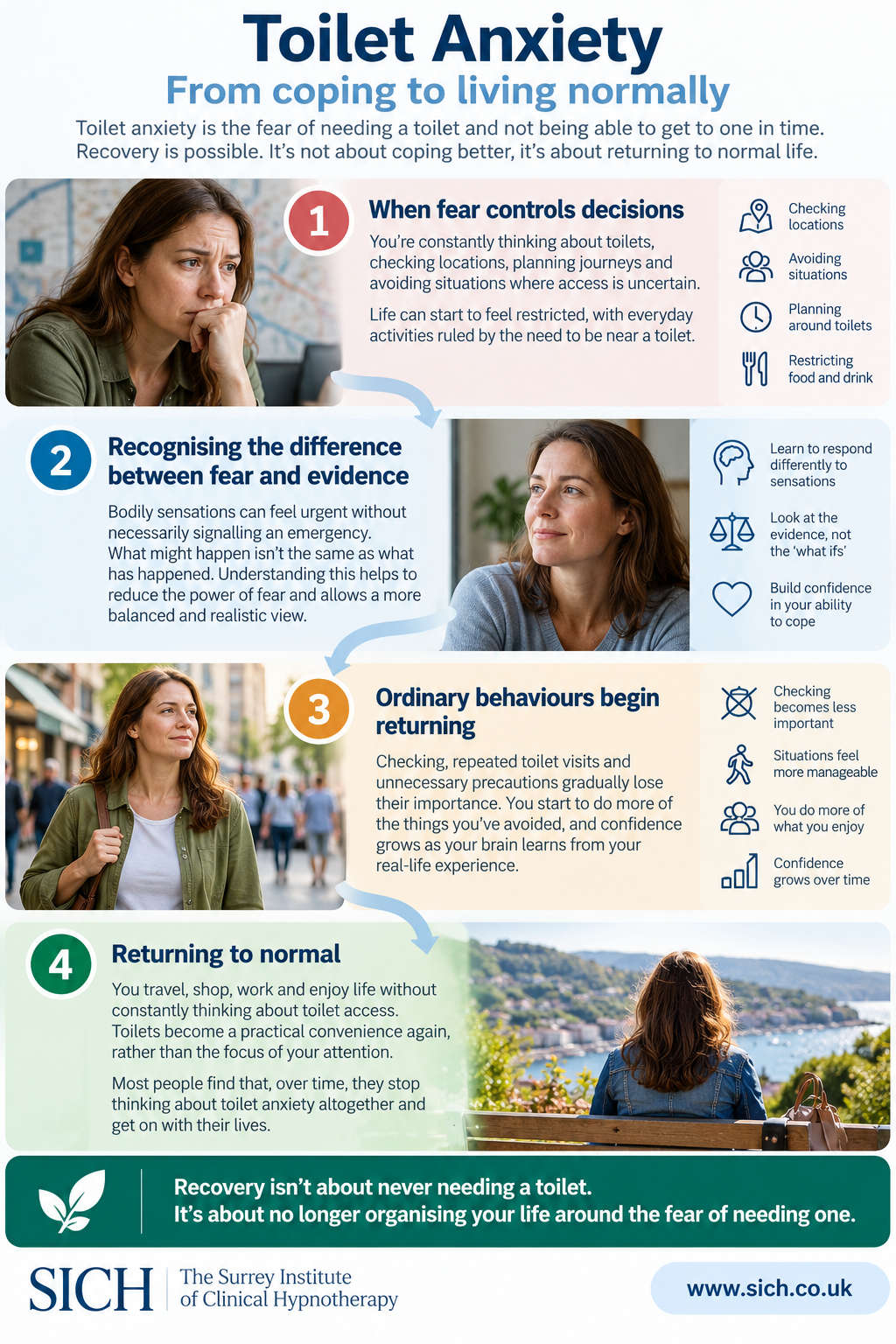
Perhaps one of the most interesting things I’ve observed is that people don’t always notice their own recovery taking place. When they’re anxious, every uncomfortable sensation, every precaution and every avoided situation becomes significant. But when those difficulties begin to disappear, there isn’t necessarily anything dramatic to attract their attention. They’re simply getting on with their lives.
During treatment, I spend time helping clients reflect on the changes they’ve experienced in their thoughts, behaviours, beliefs and feelings. Often, although certainly not always, the changes begin with thinking differently about situations, followed by changes in behaviour, then more established beliefs and emotional responses. Sometimes a client initially struggles to identify much improvement until we begin discussing what they’ve actually been doing since their previous session.
They may remember going shopping without making their usual precautionary visits to the toilet, accepting an invitation they would previously have declined or travelling somewhere without checking the facilities beforehand. What’s particularly interesting is that they haven’t necessarily made a conscious decision to abandon those habits. They’ve simply forgotten to perform them because the need for them has diminished.
I find that enormously encouraging. When someone is deliberately trying not to check for toilets, the anxiety may still occupy a considerable amount of their attention. But when they realise afterwards that they hadn’t even thought about checking, something rather different is happening. Their attention has returned to the ordinary business of living.
I’ve explored these everyday signs of improvement in more detail in my article What Recovery Looks Like for Toilet Anxiety.
Does Recovery Mean Toilet Anxiety Can Never Return?
I occasionally hear from former clients who have enjoyed several years of normal life but have begun noticing some of their old anxieties returning. Often, this follows an illness, a particularly stressful period or another event that has left them feeling vulnerable. Familiar thoughts begin appearing again, perhaps accompanied by some of the checking and avoidance behaviours they had previously left behind.
I don’t regard this as evidence that their earlier recovery wasn’t genuine. They’ve spent years doing things that were once difficult or impossible, often without giving toilet anxiety much thought at all. That experience hasn’t simply vanished because something has temporarily undermined their confidence.
In my clinical experience, people returning under these circumstances often find that two or three additional sessions are sufficient to help them regain their previous confidence, although individual responses inevitably vary. They aren’t necessarily beginning the entire process again because they already have personal experience of moving beyond their anxiety.
This is also why I’m reluctant to make absolute promises about permanent cures. Life is unpredictable, and people can experience periods of anxiety or vulnerability for all sorts of reasons. What matters is that a return of some familiar feelings doesn’t automatically mean someone is destined to return to the life they were living before treatment.
Another important point is that I don’t decide when someone has recovered. I can observe improvements and help clients recognise changes they might otherwise overlook, but ultimately they’re the ones living their lives. When they feel confident, when they can do the things they want to do and when they decide they no longer need my help, that’s their decision.
In a sense, I’m a turkey voting for Christmas. The more successfully I help someone regain their independence, the sooner they decide they don’t need to see me anymore. And that’s precisely the outcome I’m working towards.
So, Can Toilet Anxiety Be Cured?
If by a cure we mean a guarantee that someone will never again experience anxiety, urgency or an inconvenient need to use the toilet, then no, I wouldn’t make that claim. Those experiences are part of being human, and even people who’ve never experienced toilet anxiety can occasionally find themselves in uncomfortable situations.
But if the question is whether someone can reach a point where toilet anxiety no longer controls their choices, restricts their activities or occupies their thoughts throughout the day, then my answer is a very definite yes. I’ve worked with many people who describe toilet anxiety as something firmly in their past, and the accounts shared in our client reviews reflect just how significant that change can be.
It’s worth remembering that many of the people who eventually come to see me have already tried several approaches, including CBT, medication, counselling, mindfulness and other therapies. Some have begun to believe that nothing will ever work for them. But previous unsuccessful attempts don’t establish that recovery is impossible, just as another person’s successful treatment doesn’t guarantee an identical outcome for everyone.
Our toilet anxiety research examines the experiences and behavioural patterns of our first 100 completed clinical cases, while our main guide to hypnotherapy for toilet anxiety explains more about the problem and our individual approach to treatment.
For me, the purpose of treatment has never been to produce people who are exceptionally good at coping with toilet anxiety. I want them to reach the point where they no longer need to cope with it because it no longer dominates their lives. They can make plans without constantly anticipating disaster, respond naturally when they genuinely need the toilet and get on with the things that matter to them.
Ultimately, recovery isn’t about developing extraordinary confidence or achieving perfect control over the body. It’s about being able to live an ordinary life again, with all the occasional inconveniences and uncertainties that ordinary life involves.
And after years of living under the restrictions of toilet anxiety, that ordinary life can feel quite extraordinary.