
Scientists have watched brain chemicals respond to emotional words, and clinical trials suggest that certain positive thinking exercises can improve mood. It sounds like the proof we’ve been waiting for. But look a little more closely at what these studies actually measured, and a rather different picture begins to emerge.
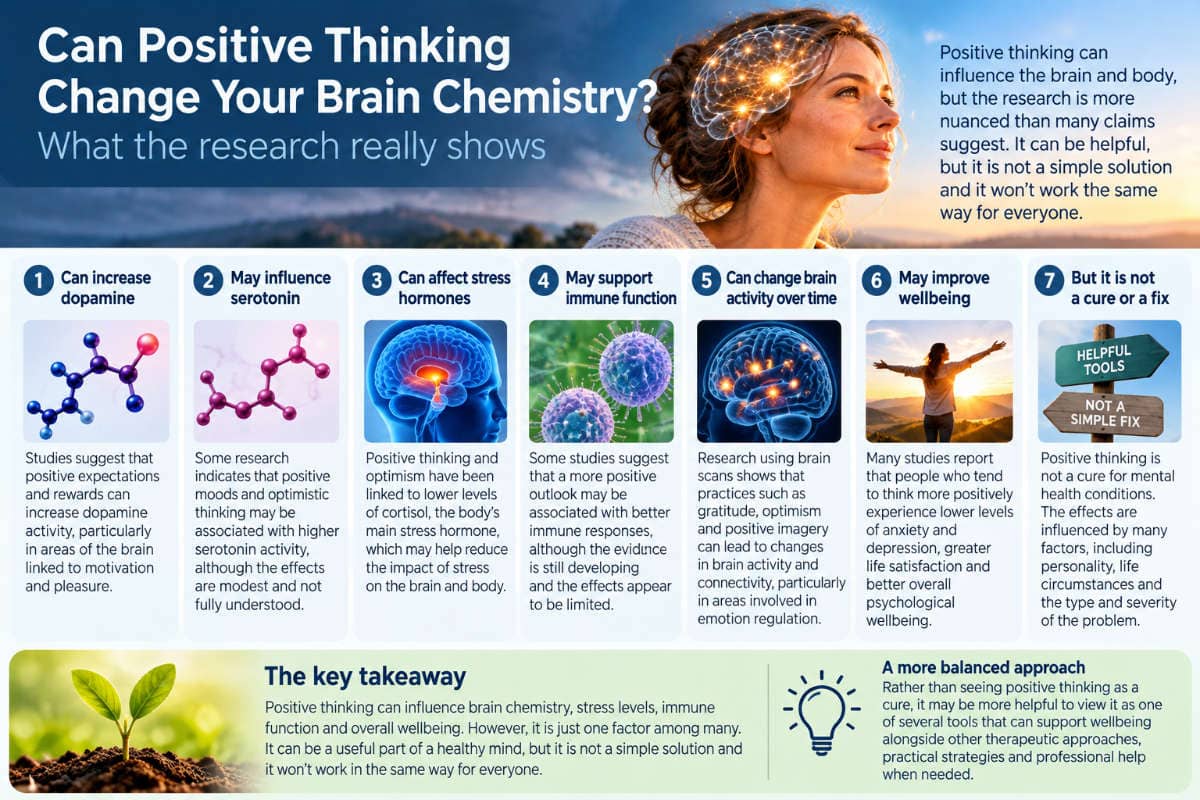
There is something irresistibly appealing about the idea that we can improve our emotional wellbeing simply by changing how we think. Social media is full of claims that positive thinking releases dopamine, increases serotonin, rewires the brain and even strengthens the immune system. Some posts go further, suggesting that our thoughts effectively control our body chemistry and, consequently, our mental and physical health.
For years, much of this has belonged more to the world of motivational speaking than established neuroscience. But recent research has complicated matters. Scientists have now demonstrated that the emotional meaning of words is associated with measurable changes in neurotransmitter activity.

Other researchers have found that deliberately cultivating positive experiences can improve psychological wellbeing, while a particularly intriguing experiment has investigated whether activity in the brain’s reward system might influence the immune response to vaccination.
These are genuine scientific findings, published in respected, peer reviewed journals. They deserve serious consideration. What they do not deserve is to be stretched into claims that the research cannot support.
To understand why, we need to distinguish between three rather different propositions: that thoughts influence brain activity, that psychological exercises can improve mood, and that positive thinking improves mood by releasing particular brain chemicals. The evidence for each is not equally strong.
The Study That Actually Measured Brain Chemicals
One of the most interesting developments appeared in January 2025, when researchers led by Virginia Tech published a study in Cell Reports examining how the human brain responds to emotionally meaningful language.
The researchers studied 19 patients undergoing neurosurgical procedures. Using a sophisticated electrochemical technique, they estimated rapid changes in three neurotransmitters, dopamine, serotonin and noradrenaline, while participants evaluated words with positive, negative or neutral emotional meanings.
This was an important advance because most research linking psychological experiences to brain chemistry relies on indirect measurements. Here, the investigators were able to examine neurotransmitter signals over extremely short periods within specific brain regions.
The results demonstrated that emotionally meaningful words were associated with different patterns of chemical activity. However, those patterns depended on which neurotransmitter was being measured, the brain region involved and, in some cases, the hemisphere.
One particularly revealing finding concerned dopamine. In part of the left anterior cingulate cortex, positive words were associated with lower dopamine responses than negative words. In the corresponding right hemisphere, a trend in the opposite direction was observed, although that particular comparison was not statistically significant.
That is hardly consistent with the popular claim that positive words simply release more dopamine.
The researchers themselves emphasised that neurotransmitter responses were complex and regionally specific. They did not identify a straightforward relationship in which positive words released one chemical and negative words released another.
There are also limitations. Only 13 patients contributed measurements from the thalamus and six from the anterior cingulate cortex. The patients were undergoing surgery for neurological conditions, and recording locations were determined by clinical necessity. These were not measurements of otherwise healthy people practising positive affirmations.
Perhaps most importantly, the researchers were investigating how the brain processes emotional language. They were not testing whether deliberately thinking positively improves mood, and they did not measure lasting psychological benefits.
The study establishes something scientifically valuable: emotional language is associated with measurable neurochemical responses. The suggestion that repeating positive statements will therefore make us happier is an additional hypothesis, not a finding of this experiment.
Dopamine and Serotonin Are Not Simply Happiness Chemicals
Part of the confusion comes from the way neurotransmitters are described in popular discussions of mental health.
Dopamine is frequently called the pleasure chemical, while serotonin is presented as the chemical responsible for happiness. These descriptions are attractive because they reduce an enormously complicated system to something easy to understand.
Unfortunately, they are misleading.
Dopamine is involved in motivation, learning, reward prediction and the significance we attach to experiences. It is not simply released whenever something makes us happy. Dopamine signalling also participates in responses to unpleasant or unexpected events, depending on the neural circuits involved.
Serotonin has similarly diverse functions, influencing processes associated with mood, cognition, behavioural regulation and learning. Its effects depend on receptor types, neural pathways and interactions with other signalling systems.
Noradrenaline contributes to attention, alertness and responses to changing demands. It is no more exclusively a stress chemical than dopamine is exclusively a pleasure chemical.
The Virginia Tech findings illustrate precisely why the familiar social media explanation is inadequate. Neurotransmitters operate within interconnected systems, and their effects cannot be understood simply by measuring whether the amount of one chemical increases or decreases.
Even if a particular thought produces a measurable chemical response, that does not automatically tell us whether the person feels happier, whether the change is beneficial, or whether repeating the thought would produce a lasting improvement.
Can Positive Expectations Influence the Immune System?
A second study, published in Nature Medicine in January 2026, takes the question in another direction.
Researchers led by Nitzan Lubianiker investigated whether people could learn to increase activity in brain pathways associated with reward and positive expectations, and whether this might be related to their immune response.
The randomised trial involved 85 healthy participants. Some received specialist brain training using functional MRI neurofeedback, allowing them to see how their brain activity responded to different mental strategies. Other participants received a comparison form of neurofeedback or no neurofeedback.
Following four training sessions, participants received a hepatitis B vaccination, and researchers subsequently measured their antibody responses.
The findings were intriguing. Greater activation of the ventral tegmental area, a region involved in reward processing, was associated with larger increases in vaccine antibodies. Participants who successfully sustained activity in this region often used mental strategies involving positive expectations.
That sounds like compelling evidence for the influence of the mind on the body. And it is certainly evidence worth investigating.
However, there is a crucial qualification. The researchers found an association between activity in a particular brain region and antibody responses. They did not demonstrate that positive thinking, by itself, improved immunity. Indeed, antibody responses did not differ significantly between the randomised treatment groups.
The experiment also did not directly measure dopamine release, and it did not establish that participants were better protected against infection.
The study provides an interesting possible mechanism linking psychological processes, reward circuitry and immune function. But it remains preliminary evidence, not justification for claiming that optimistic thoughts strengthen immunity or that people can think themselves into better physical health.
What Happens When We Examine Thousands of Participants?
While neuroscience can help explain possible mechanisms, clinical trials are more useful when asking whether a psychological intervention actually makes people feel better.
In January 2026, researchers published a substantial systematic review and network meta analysis in Nature Human Behaviour. It examined 183 randomised controlled trials involving 22,811 participants.
The review included positive psychology exercises, mindfulness, compassion based interventions, physical exercise, yoga and several other approaches intended to improve wellbeing.
Most interventions produced improvements compared with inactive control conditions. Positive psychology exercises, particularly individual practices such as gratitude exercises, showed moderate beneficial effects. Mindfulness, yoga and compassion interventions also demonstrated improvements of broadly comparable magnitude.
This is encouraging evidence that structured psychological activities can improve reported wellbeing.
Nevertheless, there are several reasons to resist interpreting the findings too broadly.
First, the review concentrated on adults without diagnosed clinical conditions. Improvements in general wellbeing cannot automatically be translated into effective treatment for major depression, anxiety disorders or other significant psychological difficulties.
Second, the interventions were not simply instructions to think positively. They involved different activities, often delivered within structured programmes. Some required behavioural changes or regular practice.
Third, many comparisons were against inactive controls. People receiving a structured intervention may benefit partly from attention, expectation, having a purposeful activity or other factors beyond the specific technique being studied.
The researchers also acknowledged methodological weaknesses, possible publication bias and limited evidence about longer term outcomes. Many of the underlying studies carried a moderate or high risk of bias, although sensitivity analyses generally supported the overall findings.
An additional point worth remembering is that the review was published in 2026, but its literature searches extended only to March 2023. A recent publication date does not necessarily mean the evidence it analyses is equally recent.
The reasonable conclusion is that various structured wellbeing interventions can produce meaningful, generally modest to moderate benefits. It is not evidence that optimistic thinking alone is a reliable treatment for psychological illness.
Can Fifteen Minutes of Gratitude Actually Improve Mood?
A smaller but relevant experiment appeared in Frontiers in Psychology in September 2026.
The researchers recruited 41 university students in Türkiye and randomly assigned them to complete either a gratitude writing exercise or a neutral writing task.
The writing activity lasted 15 minutes. Participants reported their emotional state before and afterwards, while researchers also recorded their heart rate at several points during the experiment.
Those completing the gratitude exercise reported significantly greater improvements in positive mood and reductions in negative mood than participants in the comparison group.
This is reasonably persuasive evidence that focusing attention on things for which we feel grateful can influence our immediate emotional experience. The presence of an active comparison condition strengthens that interpretation.
However, the experiment measured short term changes in self reported mood. It did not establish whether the improvements lasted beyond the session, whether repeated exercises would produce larger benefits, or whether the results would apply to people experiencing clinical depression.
The sample was also small and drawn entirely from one university. Participants knew which activity they were completing, creating the possibility that expectations influenced their responses.
Interestingly, the researchers found no statistically significant difference in heart rate responses between the groups. The study was too small to exclude subtle physiological effects, but it certainly did not demonstrate a general bodily relaxation response.
Once again, the psychological finding is more convincing than any proposed explanation involving brain chemistry.
The Clinical Trial That Challenges Conventional Thinking
Perhaps the most clinically relevant research appeared in JAMA Network Open in April 2026.
Researchers examined 98 adults experiencing substantial depression or anxiety alongside unusually low levels of positive emotion.
Participants were randomly assigned to one of two structured psychological treatments, each delivered over 15 weekly sessions.
Positive Affect Treatment concentrated on developing the capacity to anticipate, experience and learn from rewarding activities. Participants practised planning enjoyable experiences, engaging more fully with pleasurable activities, directing attention towards positive aspects of experience and mentally rehearsing rewarding situations.
Negative Affect Treatment concentrated on reducing distress and threat responses through approaches including cognitive restructuring, behavioural exposure and respiratory training.
Both treatments produced clinical improvements. However, the group receiving Positive Affect Treatment showed a modestly greater overall improvement, with a small effect size of approximately 0.27. That advantage remained at the one month follow up.
This is an important finding because it suggests that actively developing positive emotional experiences may sometimes be more beneficial than concentrating exclusively on reducing negative emotional responses.
But the details complicate the headline.
The advantage was driven primarily by reductions in depression and anxiety symptoms. The researchers did not find a significant advantage for Positive Affect Treatment on the separate measures of positive emotion or interviewer rated loss of pleasure.
Furthermore, both treatments improved several measures of reward processing, and the researchers were unable to demonstrate that the proposed physiological and behavioural mechanisms explained the clinical improvement.
We therefore have evidence that one structured treatment outperformed another by a modest amount in this particular population. We do not have proof that positive thoughts themselves produced beneficial neurotransmitter changes.
The absence of an untreated control group also means this experiment was designed to compare two therapies, rather than establish how much either exceeded natural recovery or nonspecific treatment effects. Follow up was limited to one month.
Nevertheless, the study raises a useful clinical question. If treatment focuses exclusively on removing distress, are we sometimes neglecting the equally important task of helping someone recover interest, enjoyment and engagement with ordinary life? That possibility deserves investigation without needing to invoke any simplistic theory about happiness chemicals.
Feeling Happier Is Not Necessarily the Same as Being Less Depressed
Another systematic review published in April 2026 examined 17 randomised controlled trials involving 2,579 participants.
The researchers evaluated positive psychology interventions against measures including happiness, positive emotions, life satisfaction and depression.
The results demonstrated statistically significant improvements in several indicators of positive wellbeing. The improvement in happiness was relatively small, with a standardised effect size of 0.25.
However, the combined findings did not demonstrate a statistically significant improvement in depression scores.
That distinction matters enormously. Feeling somewhat happier after a psychological exercise is not necessarily equivalent to experiencing a clinically meaningful reduction in depressive illness.
It is also important not to misinterpret the statistics. A result that fails to reach statistical significance does not prove that an intervention has no effect. In this review, the uncertainty around the depression estimate included the possibility of a worthwhile benefit as well as little or no benefit.
What the analysis does establish is that positive psychology interventions have more consistent evidence for improving aspects of wellbeing than for reducing depression severity.
This makes them potentially useful complementary approaches, but not established replacements for appropriate treatment of clinical depression.
When Positive Thinking Actually Makes People Feel Worse
There is another finding that tends to disappear from enthusiastic discussions of positive thinking.
Back in 2009, researchers Joanne Wood, Elaine Perunovic and John Lee published experiments examining what happens when people repeat positive statements about themselves.
They discovered that the effects depended partly on the person’s existing self esteem.
Among participants with relatively high self esteem, positive statements produced small improvements in mood. But among participants with low self esteem, repeating an extremely positive statement could leave them feeling worse.
One possible explanation is that an affirmation creates a conflict between what someone is saying and what they genuinely believe. Rather than accepting the positive message, they may become more aware of the gap between the statement and their existing self perception.
That does not mean positive thinking is harmful in general. The research examined particular affirmation exercises, not every form of positive psychological intervention.
It does, however, undermine the assumption that positive statements are universally beneficial.
There is a considerable difference between helping someone recognise a realistic possibility for improvement and encouraging them to repeat something they find completely unbelievable.
For people experiencing serious anxiety, depression or low self esteem, that difference may be particularly important.
What Does All This Mean for Hypnotherapy?
For hypnotherapists and other psychological practitioners, these findings are relevant, although perhaps not in the way that promotional material might suggest.
The neuroscience research supports the broader proposition that language, emotional meaning and expectations are associated with measurable brain processes. The clinical research provides evidence that structured activities involving attention, anticipation, emotion and behaviour can influence psychological wellbeing.
Some of these principles overlap conceptually with approaches used in hypnotherapy, particularly mental imagery, therapeutic suggestion, positive future rehearsal and the development of alternative responses to previously distressing situations.
But conceptual overlap is not proof of treatment effectiveness.
None of the seven studies examined here demonstrates that hypnosis releases beneficial amounts of dopamine or serotonin, or that hypnotic suggestion improves mood through a particular chemical pathway.
Nor can findings from gratitude exercises, reward focused psychotherapy or neurofeedback automatically be transferred to hypnotherapy. Each intervention has its own procedures, evidence base and unanswered questions.
It would be misleading to use these studies as scientific proof of what happens during hypnosis.
The more defensible interpretation is that some psychological processes relevant to therapeutic work are supported by research across several disciplines. Exactly how those processes operate during hypnosis, and how much they contribute to treatment outcomes, requires evidence specific to hypnosis itself.
This may be a less exciting claim, but it is scientifically stronger.
A Personal Perspective from Paul Howard, Senior Partner, The Surrey Institute of Clinical Hypnotherapy
After more than twenty years working as a clinical hypnotherapist, I find research like this fascinating. Not because it confirms what I already believe about the mind, but because it challenges me to question what I think I understand.
I’ve never been particularly comfortable with the idea that people can overcome significant psychological difficulties simply by thinking more positively. Apart from being an extraordinary oversimplification, it risks suggesting that those who continue to struggle simply aren’t trying hard enough.
Of course, our thoughts and expectations can influence how we feel and behave. But understanding that relationship is rather different from claiming that positive thoughts release particular brain chemicals and make us happier.

One thing my clinical experience has taught me is just how extraordinarily different people are. Two clients may experience apparently identical symptoms, yet respond quite differently to the same therapeutic approach. Recognising a psychological pattern doesn’t necessarily mean we’ve understood the individual experiencing it, and it certainly doesn’t tell us exactly how to help them.
That’s why I’m reluctant to become too attached to any particular explanation of how the mind works. I use my experience to guide me, but I’m always prepared to reconsider my assumptions when something suggests a different direction.
I also believe we should approach scientific research with that same curiosity. Respect the evidence, certainly, but recognise its limitations and remain willing to change our understanding as new findings emerge. That applies just as much to the theories used in hypnotherapy as it does to conventional psychological and medical explanations.
What interests me most about the studies discussed here is not the possibility that we might eventually discover a chemical explanation for positive thinking. It’s that each investigation adds another small piece to an extraordinarily complicated puzzle.
And perhaps that’s the point. We don’t need to pretend we understand every mechanism through which thoughts influence emotions before we can investigate what genuinely helps people.
I’d much rather offer someone an honest explanation of what the research currently tells us, including what remains uncertain, than make an impressive sounding promise that the evidence cannot support.
I’ve explored this philosophy in greater depth in my article, What If Everything I Think I Know About the Mind Is Wrong?, where I discuss why I believe every client deserves an individual approach, and why therapists should remain willing to question even their own most firmly held assumptions.
For me, helping people has always been more important than defending a theory about how their minds work.
Paul Howard
Senior Partner
The Surrey Institute of Clinical Hypnotherapy
So, Does Positive Thinking Really Work?
After examining the research, the answer depends on what we mean by positive thinking and what we expect it to accomplish.
If we mean that deliberately cultivating gratitude, anticipating pleasurable experiences or developing greater awareness of positive aspects of life can improve mood and wellbeing, there is credible evidence supporting that proposition.
If we mean that structured psychological treatments designed to increase rewarding experiences may help some people with depression or anxiety, the evidence is promising, although more extensive and longer term trials are needed.
If we mean that emotionally meaningful language influences neurotransmitter activity, recent neuroscience provides direct evidence of complex chemical responses within particular brain regions.
But if we mean that repeating happy thoughts reliably releases dopamine or serotonin, corrects a chemical imbalance, treats depression or strengthens the immune system, the evidence presented here does not justify those claims.
Perhaps the greatest misconception is that psychological benefits must be explained by a simple chemical mechanism before we can take them seriously. They do not.
Human emotions arise from interactions between brain activity, bodily processes, experience, learning, relationships and environment. It is entirely possible for a psychological intervention to improve someone’s wellbeing without researchers having identified a particular neurotransmitter responsible for that improvement.
There is also no compelling reason to believe that every unpleasant thought needs replacing with a pleasant one. Negative emotions serve important purposes, and psychologically healthy functioning includes the capacity to recognise, tolerate and respond appropriately to difficult experiences.
The most important lesson from the research may therefore be quite different from the message circulating on social media.
Positive thinking is not a chemical shortcut to happiness. Some carefully designed psychological practices can genuinely help people feel better, and scientists are beginning to understand more about the underlying processes. But the benefits are conditional, the mechanisms are complex and the effects are neither universal nor guaranteed.
That is a conclusion worth taking seriously, even if it is rather less marketable than the promise that a happy thought can change everything.