
After more than twenty years as a clinical hypnotherapist, I’ve become increasingly convinced of one thing: the greatest obstacle to understanding the human mind may be our certainty that we already understand it.
I sometimes tell people that I try not to have any beliefs about how the human mind works. Of course, that’s complete nonsense. We all have beliefs, and I’m certainly no exception. But I do make a conscious effort not to become too attached to mine, particularly when I’m working with someone who has come to me for help.
The longer I’ve worked as a clinical hypnotherapist, the more I’ve come to appreciate just how little we really understand about the extraordinary complexity of the human mind. I don’t mean that psychology and neuroscience have taught us nothing. Quite the opposite. There is an enormous body of valuable research, and some remarkable discoveries have transformed our understanding of human behaviour.
But I wonder whether there is a point at which knowledge, or perhaps our confidence in that knowledge, can begin to get in the way of curiosity.
I find that possibility fascinating. And, if I’m being completely truthful, a little uncomfortable.

Every Client Is a Puzzle I’ve Never Encountered Before
One of the things that makes my job so extraordinary is that no two clients are ever quite the same. They may arrive with what appears to be an identical problem, describe remarkably similar symptoms and even share many of the same behavioural patterns. But that doesn’t mean I understand either of them, nor does it mean that the same treatment will necessarily help them.
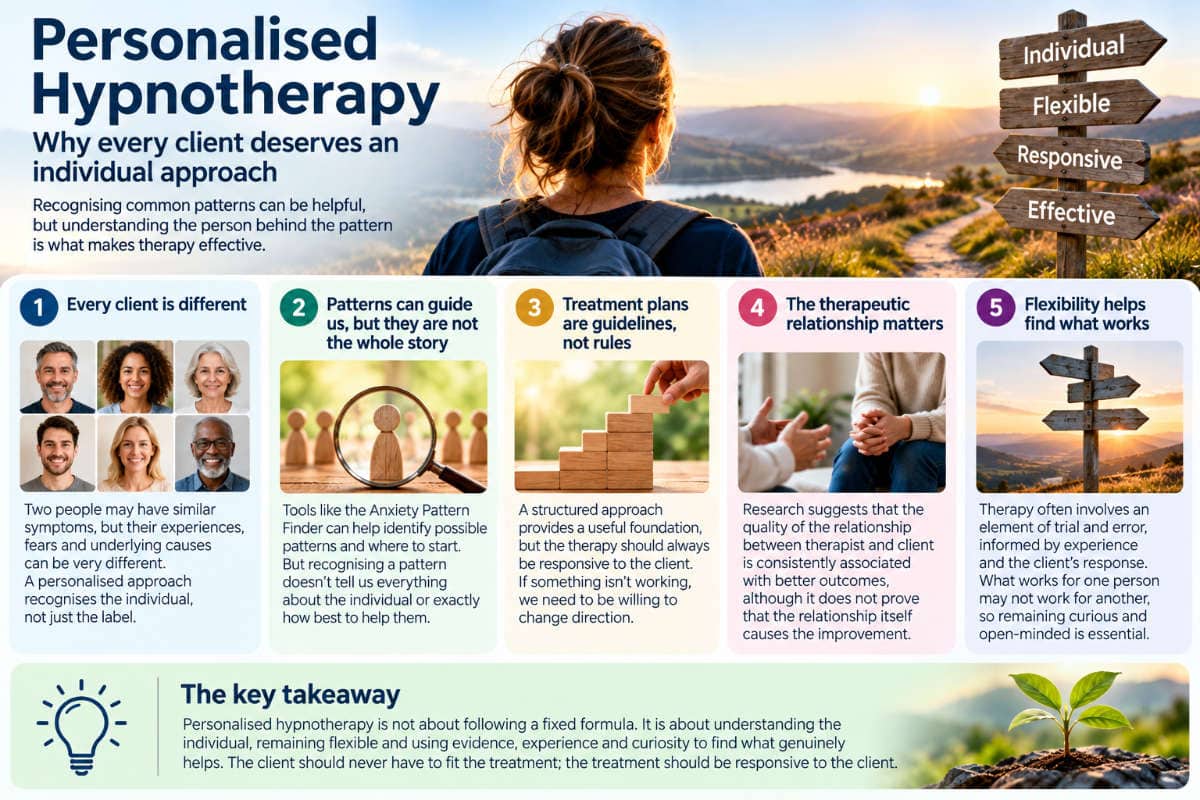
Every client is a completely different puzzle.
That isn’t simply a pleasant way of describing personalised therapy. It is central to how I approach my work.
When someone comes to me experiencing anxiety, I naturally draw upon what I’ve learnt from working with other people. It would be foolish not to. I may recognise familiar patterns, particular behaviours or ways of responding that suggest a useful direction.
But those observations are only a starting point.
The moment I assume that I know exactly what is happening because I’ve seen something similar before, I run the risk of missing something important. Perhaps there is a different emotional association, a particular experience I haven’t yet uncovered, or something about the person’s circumstances that changes how the problem needs to be approached.
Sometimes I begin working with a client thinking that one approach may be particularly helpful, only to discover something that suggests another direction altogether. When that happens, I want to be free to change course immediately.
I don’t regard that as abandoning the treatment. I regard it as responding to the client. And that is what makes the work so endlessly interesting. I’m never simply repeating what I did with someone else. I am continually trying to understand the individual in front of me.
Recognising a Pattern Is Not the Same as Understanding a Person
This distinction has become particularly important through my work with toilet anxiety, an area in which I have spent many years specialising.
At the Surrey Institute of Clinical Hypnotherapy, our ongoing Toilet Anxiety Research Project has examined the first 100 completed clinical cases in our research dataset.
Some of the recurring patterns are striking. For example, 98% of those clients reported making repeated toilet visits before leaving home, while 91% reported checking toilet access and 91% reported avoidance behaviours.
These are remarkably consistent findings within that particular clinical sample. They suggest there are recognisable features associated with toilet anxiety, despite considerable differences in individual circumstances.
But here is where I think we need to be careful.
The fact that two clients repeatedly visit the toilet before leaving home does not mean that the behaviour has precisely the same meaning for both of them. It certainly doesn’t tell me everything about how their anxiety developed, what keeps it going or what will help them change.
Nor does the identification of a common pattern establish that a single treatment method is appropriate for everyone displaying it.
Our research can help identify questions worth asking. It cannot provide a complete explanation of an individual simply because that person displays characteristics found in the dataset.
I think that distinction is easily overlooked when we become enthusiastic about identifying psychological patterns.
There is a danger of becoming so interested in the classification that we forget the person being classified.
Does Identifying the Anxiety Pattern Tell Us Where to Start?
This question is particularly relevant to another project I’ve developed at the Surrey Institute of Clinical Hypnotherapy, our Anxiety Pattern Finder.
I think it’s a fantastic tool. It asks people about the situations in which they experience anxiety, what they fear might happen and the things they do to feel safer. From their answers, it identifies possible underlying patterns, including those that may not be immediately obvious from the symptoms they describe.
For example, two people might both experience considerable anxiety when travelling, but for entirely different reasons. One might be concerned about needing a toilet, another about losing control, while someone else may fear becoming trapped somewhere they cannot easily leave.
Recognising these differences can be enormously helpful. It can direct our attention towards aspects of someone’s anxiety that might otherwise be overlooked, and it can give both the client and therapist a clearer starting point for exploration.
But here’s the difficulty.
Just because we’ve identified an anxiety pattern doesn’t mean we’ve understood the individual experiencing it. And even if we’ve correctly identified what appears to be maintaining their anxiety, that doesn’t automatically tell us how best to help that particular person change.
The Anxiety Pattern Finder can suggest where we might begin. It cannot tell us with certainty which therapeutic intervention will work, how the client will respond or whether something entirely unexpected will emerge during treatment.
In a sense, therapy involves an element of trial and error. Not randomly trying techniques in the hope that something works, but developing a reasonable working hypothesis, exploring an approach, observing the response and being prepared to reconsider our assumptions.
Sometimes identifying the pattern gives us a remarkably useful starting point. Sometimes it helps us recognise that the initial problem is more complicated than it first appeared. And occasionally, the most valuable discovery may be that we’ve been looking at the wrong part of the problem altogether.
So, does identifying the pattern tell us where to start?
Possibly. But I wouldn’t want to become so confident in the answer that I stopped listening to the client.
That would rather defeat the purpose of developing the tool in the first place.
Treatment Plans Should Be Guidelines, Not Rules
Over the years, I’ve developed a number of structured treatment programmes. They provide a useful foundation for addressing particular difficulties, drawing upon approaches and techniques that I’ve found helpful in clinical practice.
But I’ve never regarded those programmes as instructions that must be followed regardless of how someone responds.
To borrow a little wisdom from Pirates of the Caribbean, they’re guidelines rather than rules.
The programme gives me a direction, not a destination that must be reached by a prescribed route.
If a client responds particularly well to one approach, I may explore it further. If something isn’t helping, I need to consider why. Perhaps my understanding of the problem is incomplete. Perhaps the timing is wrong, the approach doesn’t suit the person, or something more important has emerged during our conversations.
What matters is not whether I have successfully followed the programme. It’s whether the work is helping the individual.
I would find it very difficult to justify persisting with an approach simply because that was what I had originally planned to do.
That doesn’t mean every established method should be discarded or that improvisation is automatically better. A structured approach can be extremely useful. But I believe its value lies in what it contributes to the client’s progress, not in how faithfully it is followed.
The client should never have to fit the treatment. The treatment should be responsive to the client.
What Does the Research Say About Individualised Therapy?
Interestingly, research into psychotherapy provides some support for the importance of the relationship between the therapist and the individual, although we need to be careful about what that research actually demonstrates.
A substantial meta analysis published in 2018 examined 295 independent studies involving more than 30,000 clients. It found a consistent association between the quality of the therapeutic alliance and treatment outcomes across different therapeutic approaches.
The therapeutic alliance concerns the working relationship between client and therapist, including their agreement about goals, their understanding of the work and the quality of their relationship.
That finding is important, but it doesn’t prove that a good relationship causes successful treatment. It is also possible that people who begin improving develop greater confidence in their therapist, or that other factors influence both the relationship and the outcome.
A more recent 2025 meta analysis examined the effects of client preferences and active treatment choice. It reported significant associations with treatment satisfaction, completion and clinical outcomes.
Meanwhile, a 2024 systematic review of therapist responsiveness explored how therapists recognise and respond to individual client needs. The authors identified considerable difficulties in defining and measuring responsiveness, reflecting how complex this aspect of therapeutic work can be.
None of these studies demonstrates that my particular approach to hypnotherapy is superior to a more structured one. Nor do they establish that every treatment decision should be improvised.
What they do suggest is that the individual client’s experience, preferences and relationship with their therapist deserve serious consideration alongside the treatment method itself.
For me, that is an encouraging area of research.
The Problem With Becoming Too Certain
I have enormous respect for medical science and the expertise of those working within it. The NHS is an extraordinary organisation, and modern medicine has achieved things that would once have seemed almost unimaginable.
But I don’t believe that respecting expertise requires us to regard current medical understanding as the final word on every question.
Even highly knowledgeable professionals work within established frameworks of understanding. Those frameworks influence which questions are asked, which explanations seem plausible and how evidence is interpreted.
This is not a failing unique to conventional medicine. It can happen in any profession, including hypnotherapy.
Indeed, I sometimes wonder whether my own twenty years of clinical experience could become as much of an obstacle to understanding as a source of knowledge.
If I’ve encountered a particular problem hundreds of times, I might be tempted to assume that I recognise it immediately. I may even feel confident that I understand what is maintaining it.
But how do I know?
I can observe what happens during therapy. I can listen to what clients report and look for changes in their behaviour. I can develop working explanations about why particular interventions appear helpful.
What I cannot do, simply through clinical experience, is establish beyond doubt that my preferred explanation is correct.
Perhaps a different intervention would have worked equally well. Perhaps something I hadn’t recognised contributed to the improvement. Or perhaps my explanation is only part of a much more complicated picture.
None of that makes clinical experience worthless. I regard it as enormously valuable.
But experience should inform our questions, not prevent us from asking them.
There is another aspect of this that particularly interests me as a hypnotherapist, and that is the influence of language and expectation.
When someone receives an explanation of their condition from a medical professional, the words used can carry considerable authority. This is understandable. People seek medical advice because they want answers from someone with specialist knowledge.
But I think we should be careful about the difference between explaining the current limits of treatment and making an absolute statement about someone’s future.
For example, there is a distinction between saying that no reliably effective treatment has yet been established for a particular condition and telling someone that nothing can be done for them.
Sometimes a difficult prognosis is entirely justified. People deserve honesty, even when the news is unwelcome.
My concern arises when uncertainty becomes certainty in the way information is communicated.
Words can influence expectations, and expectations can influence how people interpret their experiences. That doesn’t establish that a medical statement will create or maintain a psychological problem, but it is a possibility worth taking seriously rather than dismissing.
And, of course, hypnotherapists must be equally careful. We should never give clients unrealistic promises or present our own assumptions as established scientific facts simply because our words may carry therapeutic authority.
I Don’t Want to Replace One Set of Beliefs With Another
It would be easy to turn this into an argument about conventional medicine versus complementary therapy. But that would miss the point entirely.
I’m not interested in proving that one profession has all the answers and another has none.
In fact, I think one of the dangers within hypnotherapy is that practitioners can become just as attached to their preferred theories as anyone working within a more established psychological discipline. An explanation may sound convincing. It may fit comfortably with what we’ve observed. It may even have been taught for decades. None of those things automatically makes it correct.
When I mentor therapists, one of the qualities I want to encourage is intellectual curiosity. I don’t want them to accept my explanations simply because I’ve been practising longer than they have.
If they discover something that challenges what I believe, I want to hear about it.
I would find it far more troubling if a therapist stopped questioning a method because it had become part of their professional identity.
The same principle applies when working directly with clients. I need to remain willing to reconsider my understanding of their difficulties, even if doing so means acknowledging that my original interpretation was wrong.
That isn’t always comfortable. But I suspect the willingness to be wrong is one of the most useful qualities a therapist can develop.
Perhaps Understanding the Mind Means Becoming Comfortable With Uncertainty
I don’t think it’s possible to practise hypnotherapy without developing beliefs about how the mind works. We need working explanations, and we need methods that have some reasonable basis for expecting them to help.
But I would much rather regard those explanations as provisional than become so committed to them that I stop noticing what contradicts them.
There is a difference between having confidence in your ability to help someone and having certainty about exactly how their mind operates.
I try to maintain the former without becoming trapped by the latter.
Every client reminds me that human experience is extraordinarily varied. What appears obvious at the beginning of a session may become less certain as we explore it. An approach I expected to be useful may turn out to be less appropriate than something I hadn’t originally considered.
And occasionally, the most interesting discovery is that the question I started with wasn’t quite the right question.
That is what I love about this profession. There is always something more to learn, another assumption to examine, another perspective I hadn’t considered.
After more than twenty years, I certainly know more than I did when I started. But I’m not convinced that means I should be more certain about everything.
Perhaps the real value of experience is not that it gives us all the answers, but that it teaches us how careful we need to be with the answers we think we’ve found.
I would rather spend the rest of my career discovering that some of my assumptions were wrong than spend it defending those assumptions simply because they have become familiar.
Because ultimately, the person sitting in front of me is far more important than any theory I happen to hold about them.
And if changing my mind helps me understand that person a little better, then changing my mind is exactly what I should be prepared to do.
Paul Howard
Senior Partner
The Surrey Institute of Clinical Hypnotherapy