
Toilet anxiety appears to be far more common than most people realise, but it is rarely measured directly because sufferers often describe it as IBS anxiety, travel anxiety, panic, agoraphobia, embarrassment, bladder anxiety, bowel anxiety, paruresis or a fear of being caught without toilet access.
In the SICH Toilet Anxiety Research Project, based on 100 anonymised completed clinical cases, the pattern was clear: toilet anxiety affected people across a wide age range, with an average symptom duration of around 16 years before seeking specialist help. 76% reported no adult accident, yet 100% of valid safety-behaviour cases used at least one coping behaviour, such as checking toilet access, avoiding journeys, restricting food or drink, distraction, medication or carrying emergency supplies.
So the short answer is: toilet anxiety is probably under-recognised rather than rare. Many people live with it privately for years, often believing they are the only one.
If you are asking “how common is toilet anxiety?”, you are probably not asking out of curiosity.
You are probably asking because some part of your life has started to revolve around toilets, journeys, timing, food, drink, exits, queues or the fear of being too far from help.
And you want to know one thing:
Is this just me?
The honest answer is no, it is not just you.
The harder answer is that we do not yet have a reliable population prevalence figure for toilet anxiety. It is not usually counted properly. It is often hidden under other labels, such as IBS, travel anxiety, panic attacks, agoraphobia, social anxiety, a sensitive stomach, fear of being trapped, or fear of being too far from a toilet.
That means many people may be living with toilet anxiety without ever using those words.
At SICH, we are regularly contacted by clients from across the UK and around the world who are looking for specialist help with this exact problem. They may describe different triggers, different histories and different levels of disruption, but the core fear is often the same:
What if I need a toilet and cannot get to one in time?
The SICH Toilet Anxiety Research Project does not prove how common toilet anxiety is in the general population. What it does show is that, among people who seek specialist help, toilet anxiety follows a recognisable and repeated pattern.
The findings on this page are based on the first 100 completed or closed anonymised clinical cases in the SICH Toilet Anxiety Research Project.
So while we cannot give a confirmed population percentage, we can say this with confidence: toilet anxiety is not a strange one-off problem. It is a real, repeated and highly disruptive anxiety pattern, and many people hide it for years before getting the right help.
For the full clinical dataset and research commentary, see the SICH Toilet Anxiety Research Project.
In this article, we explore how widespread toilet anxiety is, the real impact of the condition, why traditional treatments often fail, and how our specialised hypnotherapy provides a highly effective solution.
Paul Howard
A Silent Struggle Where Millions May Be Suffering In Silence
Toilet anxiety is hard to count because it is hard to admit.
People do not usually announce it. They disguise it. They manage it. They build routines around it. They become experts at making their lives look normal from the outside.
They may still go to work.
They may still take their children to school.
They may still meet friends.
They may still go shopping.
They may still travel, but only after checking every toilet on the route.
From the outside, it can look like organisation. From the inside, it can feel like a private survival plan.
A person may avoid long journeys, refuse meals out, leave meetings early, check toilet access everywhere they go, restrict food or drink before leaving home, or plan their whole day around whether they can get to a toilet quickly enough.
But when they explain the problem, they may not say “I have toilet anxiety”.
They may say:
- “I have IBS.”
- “I get travel anxiety.”
- “I panic in traffic.”
- “I don’t like being trapped.”
- “I need to know where the toilets are.”
- “I can’t go far from home.”
- “I don’t trust my body.”
Different words. Same hidden pattern.
This is why the question “how common is toilet anxiety?” is so difficult to answer from official figures alone. The problem is often not named, not disclosed and not measured.
SICH is regularly contacted by clients from around the world who are looking for help with toilet anxiety. That alone suggests this problem is far more common than many people realise.
It does not give us an exact population prevalence figure. But it does give a very real picture of how often toilet anxiety appears in day-to-day life, and how many people struggle to find the right words, the right explanation and the right specialist help.
The SICH clinical data supports the idea that many people live with the condition for a long time before seeking help. In the first 100 completed or closed anonymised cases, the average reported symptom duration was 15.815 years, rounded to 16 years. The median duration was 12 years, and the reported range was 1 to 60 years.
That is a long time to organise life around toilets, exits, journeys, food, drink, meetings and escape routes.
So while we cannot give a confirmed population percentage, it is reasonable to suspect that millions of people may be affected by some form of toilet-related anxiety, many of them without ever using that phrase.
Part of the reason toilet anxiety is so hard to count is that it rarely announces itself.
It may look like someone always driving rather than taking the train. It may look like someone avoiding restaurants, turning down invitations, leaving early, choosing aisle seats, checking maps before agreeing to go anywhere, or asking “how long will we be there?” before deciding whether to say yes.
It may look like someone who seems organised, careful or particular, when in reality they are quietly calculating risk.
- How far from home will I be?
- Will there be a toilet nearby?
- What if there is a queue?
- What if the toilet is out of order?
- What if I am stuck in traffic?
- What if I am in a meeting and cannot leave?
- What if someone notices?
- What if my body lets me down?
This is why the question “how common is toilet anxiety?” is difficult to answer. Many people do not present it as toilet anxiety. They present it as travel anxiety, IBS anxiety, panic, avoidance, social anxiety, agoraphobia, fear of public transport, fear of being trapped, or simply a need to stay close to home.
From the outside, the pattern may be almost invisible. From the inside, it can shape the whole day.
The person may still work, parent, travel, shop, socialise or attend appointments, but only after layers of planning that nobody else sees. They may not be housebound. They may not look anxious. They may even appear confident. But behind that appearance, their world may be organised around one private question:
What if I need a toilet and cannot get to one in time?
76% Reported No Adult “Accident”, Yet Still Lived In Fear Of One
This is one of the most powerful findings in the SICH Toilet Anxiety Research Project.
76% of clients reported no adult “accident”. Yet many still lived every day as though one could happen at any moment.
That is the cruel trick of toilet anxiety. The fear does not wait for proof. It does not need a long history of accidents. It only needs the thought, “what if I can’t get there in time?” Once that thought is believed by the body, the whole world can start to shrink.
- A car journey becomes a risk.
- A meeting becomes a trap.
- A queue becomes a threat.
- A restaurant becomes something to calculate.
- A day out becomes something to survive.
This is why toilet anxiety is so often misunderstood. From the outside, it can look excessive. From the inside, it feels urgent, physical and impossible to ignore.
The person may know, logically, that the feared disaster has not happened repeatedly. But toilet anxiety does not run on logic. It runs on prediction, anticipation and body-level alarm.
That prediction can lead to elaborate coping behaviours:
- Mapping toilet locations
- Visiting the toilet repeatedly before leaving home
- Avoiding certain roads, trains or social events
- Restricting food or drink
- Carrying emergency supplies
- Sitting near exits
- Leaving early
- Checking and rechecking whether a toilet will be available
These behaviours can feel like the only thing keeping the person safe. But they can also become the very reason the fear grows stronger. Each time the person checks, avoids, restricts or escapes, the brain may learn the same dangerous lesson:
“I only got through that because I protected myself.”
That is how toilet anxiety becomes a prison built out of precautions.
And this is where the question “how common is toilet anxiety?” becomes more than a numbers question. If so many people can live for years with a fear that is hidden, private, embarrassing and rarely named properly, then the true scale of the problem may be far greater than official figures suggest.
Many people are not saying, “I have toilet anxiety.”
They are saying:
- “I can’t go far from home.”
- “I need to know where the toilets are.”
- “I don’t eat before travelling.”
- “I avoid motorways.”
- “I panic if I’m stuck in traffic.”
- “I can’t sit through meetings.”
- “I don’t trust my body.”
Different words. Same pattern.
If any of the terminology feels unfamiliar, the toilet anxiety glossary explains the key terms in plain English.
The Flaws In Conventional Treatment Approaches
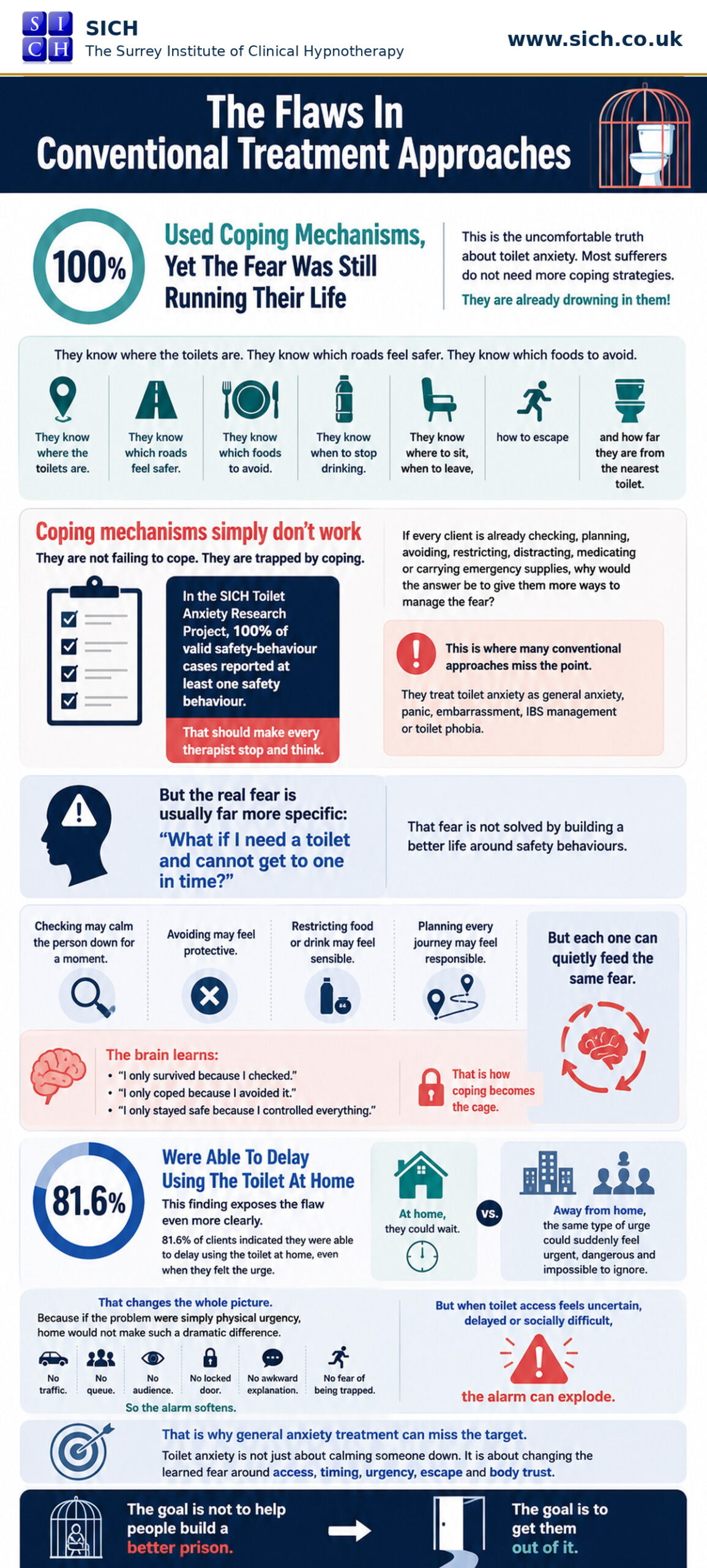
100% Used Coping Mechanisms, Yet The Fear Was Still Running Their Life
This is the uncomfortable truth about toilet anxiety. Most sufferers do not need more coping strategies.
They are already drowning in them!
They know where the toilets are. They know which roads feel safer. They know which foods to avoid. They know when to stop drinking. They know where to sit, when to leave, how to escape and how far they are from the nearest toilet.

They are not failing to cope. They are trapped by coping.
In the SICH Toilet Anxiety Research Project, 100% of valid safety-behaviour cases reported at least one safety behaviour.
That should make every therapist stop and think.
If every client is already checking, planning, avoiding, restricting, distracting, medicating or carrying emergency supplies, why would the answer be to give them more ways to manage the fear?
This is where many conventional approaches miss the point.
They treat toilet anxiety as general anxiety, panic, embarrassment, IBS management or toilet phobia.
But the real fear is usually far more specific:
“What if I need a toilet and cannot get to one in time?”
That fear is not solved by building a better life around safety behaviours.
- Checking may calm the person down for a moment.
- Avoiding may feel protective.
- Restricting food or drink may feel sensible.
- Planning every journey may feel responsible.
But each one can quietly feed the same fear.
The brain learns:
- “I only survived because I checked.”
- “I only coped because I avoided it.”
- “I only stayed safe because I controlled everything.”
That is how coping becomes the cage.
81.6% Were Able To Delay Using The Toilet At Home
This finding exposes the flaw even more clearly.
81.6% of clients indicated they were able to delay using the toilet at home, even when they felt the urge.
At home, they could wait.
Away from home, the same type of urge could suddenly feel urgent, dangerous and impossible to ignore.
That changes the whole picture. Because if the problem were simply physical urgency, home would not make such a dramatic difference. At home, there is no traffic. No queue. No audience. No locked door. No awkward explanation. No fear of being trapped. So the alarm softens.
But when toilet access feels uncertain, delayed or socially difficult, the alarm can explode.
That is why general anxiety treatment can miss the target. Toilet anxiety is not just about calming someone down. It is about changing the learned fear around access, timing, urgency, escape and body trust.
The goal is not to help people build a better prison.
The goal is to get them out of it.
Only 9% Experience The Issue At Home
This is one of the clearest signs that toilet anxiety is not usually a simple physical problem.
For most sufferers, home is the safest toilet environment. The toilet is nearby. There is no queue, no traffic, no social pressure, no awkward explanation and no uncertainty about access.
That matters.
If someone can delay using the toilet at home, but suddenly feels desperate in traffic, on a train, in a meeting, at a restaurant or away from a trusted toilet, the problem is not just the body. It is the brain’s alarm response.
The urge may feel physical, but the trigger is often situational.
The brain has learned:
- “I am safe when toilet access is certain.”
- “I am in danger when toilet access is uncertain.”
That is toilet anxiety.
If the issue also happens at home, when the person is relaxed and close to a toilet, then a physical issue is more strongly indicated and should be properly considered.
This distinction matters because many people spend years treating toilet anxiety as if it is purely physical, when for most clients in our dataset the pattern was clearly linked to access, safety, timing and control.
For 91% of clients, the issue was not happening at home in the same way.
That is not random.
That is the pattern.
The Real Life Impact Of Toilet Anxiety
Catastrophic overthinking is one of the reasons toilet anxiety can become so disruptive.
For many sufferers, “toilet anxiety comes out of the blue” is not someone being dramatic. It is simply how it feels. One moment they are getting on with the day. The next, their mind is running ahead to every possible thing that could go wrong.
- What if I need the toilet?
- What if there is no toilet nearby?
- What if there is a queue?
- What if I am stuck in traffic?
- What if I cannot leave the meeting?
- What if people notice?
- What if I do not make it in time?
That kind of overthinking can turn ordinary life into a risk assessment. Social gatherings, restaurants, holidays, long journeys, work meetings, school runs and public transport all start to feel like situations that need to be calculated before they can be faced.
The person may avoid events, cancel plans, restrict food or drink, repeatedly check toilet access, or feel unable to relax until they know exactly where the nearest toilet is.
This is how toilet anxiety spreads. It does not always spread because the body is unsafe. It spreads because the mind keeps rehearsing disaster.
Over time, that creates secondary anxieties. The person may begin with fear around toilet access, but gradually become anxious about travel, traffic, queues, meetings, eating out, social events or being too far from home.
And that is another clue to how common toilet anxiety may be. Many people are not saying, “I have toilet anxiety.” They are saying, “I overthink every journey,” “I panic if I do not know where the toilet is,” or “I cannot relax unless I have a plan.”
Different words.
Same pattern.
Toilet anxiety is not just a fear of needing the toilet. It becomes a fear of living without a plan.
A Case Study: The Train Journey That Becomes A Battle
Even something as simple as taking a train journey can become a source of overwhelming fear. The anxiety begins long before they even leave home.
- “What if there’s no toilet on the train?”
- “I checked the website, and it said this train had a toilet, or was that the next one?”
- “What if it’s out of order?”
- “What if someone is in there and I can’t wait?”
By the time they reach the station, the fear has escalated to the point where they are already considering cancelling the journey. Even if they board the train, they may spend the entire trip scanning the carriage, hyper aware of every movement around the toilet door. Their thoughts spiral into worst case scenarios, reinforcing the belief that they are constantly at risk.
The need for certainty causes endless second guessing and overanalysing, making even the most routine journeys exhausting. They are not just afraid of needing the toilet, they are terrified of the gut wrenching panic that comes with feeling trapped, out of control, and unable to escape the fear. This is why so many sufferers say they feel their life is ruled by Toilet Anxiety, and it is another lived answer to the question How Common Is Toilet Anxiety.
Why Traditional Treatments Often Fail
Our research into toilet anxiety has identified the most common treatment approaches people try before entering our specialised Toilet Anxiety treatment. It also shows something else, when people finally seek specialist help, the question “How Common Is Toilet Anxiety?” usually comes with a second question, “why has nothing else worked?”
“I have never spoken to, met or been contacted by anyone who has found any other treatment to be effective for toilet anxiety. If you know someone, pass on my number, I would love to talk to them!”
Paul Howard
The fact that so many individuals seek our help only after trying multiple other treatments is telling. It highlights how often these methods fail to provide real, lasting change, and it gives us yet another data point on How Common Is Toilet Anxiety among people who have already tried to fix it alone.
In our first session, many clients tell us that Toilet Anxiety has taken over their life, often after they have tried multiple conventional treatments that failed to provide any real, lasting change.
According to our research, the most common treatment approaches people try first are:
- Medication: Some doctors prescribe anti anxiety medication or laxatives for relief, but this does not tackle the underlying fear response.
- CBT (Cognitive Behavioural Therapy): This is often helpful but does not always reach the deep subconscious fears driving the anxiety.
- Toilet Mapping Apps: While these provide short term comfort, they reinforce the belief that finding a toilet is a constant priority.
- Dietary Adjustments: While managing food and drink intake may help physical symptoms, it does not remove the fear itself.
So, What Actually Works?
60% of clients seeking help for toilet anxiety had never tried any previous treatment before.
That tells us something important. Toilet anxiety is not just poorly treated. It is often not treated at all.
Many sufferers live with it for years, building their life around toilets, routes, food, drink, exits and escape plans, without ever finding someone who properly understands what the problem is.
That is one reason the question “How common is toilet anxiety?” matters so much. If 60% of clients reaching specialist help had never tried treatment before, how many more are still managing it alone?

Treating toilet anxiety effectively requires a specialised approach. It is not enough to manage symptoms, map toilets, practise coping techniques or force people into distressing exposure exercises.
The real work is to change the learned fear response.
Toilet anxiety is usually built around one core prediction:
- “What if I need a toilet and cannot get to one in time?”
That prediction has to be changed where the fear is being generated, not just managed at the surface.
How Hypnotherapy Provides A Permanent Solution
How Hypnotherapy Changes The Fear Pattern
Unlike approaches that focus mainly on conscious coping, specialist hypnotherapy works with the subconscious mind to retrain the fear response.
The first step is identifying the conditioning and sensitising events that may have taught the brain to associate toilet access with danger. Sometimes there is a clear trigger. Sometimes the pattern has been built slowly through near misses, embarrassment, illness, family influence, panic, avoidance or years of repeated checking and restriction.
Where necessary, a new normal is established. This means helping the subconscious build calmer, safer associations with ordinary situations, travelling, eating, meetings, social events, being away from home and trusting the body without constant checking.
The aim is not to help the client tolerate toilet anxiety. The aim is to stop the brain treating normal uncertainty as an emergency.
Perhaps most importantly, treatment has to rebuild internal trust in the body. Many sufferers do not just fear toilets. They fear their own body. They do not trust it in traffic, meetings, restaurants, trains, queues, holidays or anywhere they cannot instantly escape.
Restoring that trust is one of the biggest milestones in recovery.
These methods are not random techniques thrown together. They need to be applied in the right order, so the subconscious can accept the change rather than resist it.
Most clients see a significant recovery within just 4 to 5 sessions, with many reporting noticeable improvements even after the first session.
Rapid And Lasting Results
Most clients in the SICH Toilet Anxiety Research Project completed treatment in around 4 to 5 sessions, with the average across the first 100 closed cases being 4.96 sessions.
That does not mean every case is simple. Many clients have lived with toilet anxiety for years, often decades.
But once the maintaining mechanism is identified and treated correctly, change can often happen far more quickly than people expect.
Many clients who once felt ruled by toilet anxiety begin to travel, eat out, attend meetings, visit friends, go on holiday and live with a level of freedom they had almost stopped believing was possible.
That is why this page matters.
If so many people are still hiding toilet anxiety, managing it, mislabelling it or trying to survive it alone, then far too many may also be missing the chance to recover.
Breaking Free From Toilet Anxiety For Good
Breaking Free From Toilet Anxiety For Good
Imagine leaving the house without planning your route around toilets.
Imagine travelling without scanning every road, station, queue or exit.
Imagine going to a restaurant, a meeting, a cinema, a holiday or a day out without your first thought being, “what if I need the toilet?”
That is what recovery is really about.
- Not just coping better.
- Not just hiding it better.
- Not just finding a better toilet map.
Toilet anxiety does not have to define your life. With the right approach, the brain can learn that toilet access uncertainty is not an emergency, that body sensations are not always danger signals, and that you can begin to trust your body again.
And if you have been quietly searching “how common is toilet anxiety?”, there is a good chance you were not only looking for statistics.
You were looking for proof that you are not the only one. And maybe, quietly, you were also looking for a way out.
The Path To Freedom
- Recognise the real pattern. Toilet anxiety is often a learned alarm response, not simply a physical necessity.
- Stop building life around safety behaviours. Checking, avoiding, restricting and planning may feel protective, but they can keep the fear alive.
- Use the right approach. Traditional methods often fail because they focus on symptoms, reassurance or coping, rather than the underlying fear pattern.
- Rebuild trust in the body. Recovery is not just about toilets. It is about feeling safe enough to live without constant calculation.
- Take the first step. The sooner you address the real cause of toilet anxiety, the sooner life can start to open up again.
If you recognise yourself in these patterns, our main guide on why toilet anxiety ruins my life and what to do about it will walk you through what recovery can look like.
Ready to take back control? Contact the Toilet Anxiety specialists at The Surrey Institute of Clinical Hypnotherapy today and start your journey to freedom.