
If you keep asking how do I stop overthinking, the short answer is this, you usually do not get out by thinking harder. You get out by changing the loop that keeps pulling you back in, the checking, the analysing, the rehearsing, and the constant attempt to feel certain before you can relax.
That matters because most advice stays on the surface. People are told to distract themselves, think positive, keep busy, or challenge every thought. Sometimes that helps a bit, but often it leaves the main pattern untouched. If you want a more guided route out, the overthinking programme is the main next step on this page, because it is built around interrupting the pattern rather than feeding it.

It is also worth saying early that overthinking does not always stay general. Sometimes it latches onto one specific fear and then builds an entire system around it. A clear example is toilet anxiety, where the mind starts scanning, predicting, rehearsing and checking around urgency, escape and what might happen if you cannot get to a toilet in time. In that kind of problem, the overthinking matters, but it is part of a bigger loop.
This page is here to answer the question how do I stop overthinking in a more useful way, by showing you what keeps the loop going, why common advice often falls short, and what tends to work better when you want real change.
On this page
Why Overthinking Feels Impossible To Stop
When people ask how do I stop overthinking, they often imagine the answer should be simple. Just stop doing it. Just let it go. Just think about something else. But overthinking rarely feels optional when you are inside it.
That is because it usually does not feel like overthinking in the moment. It feels like problem solving. It feels responsible. It feels like you are trying to prevent something, understand something, or get certainty before you relax. The loop disguises itself as common sense.
That is one reason it feels so sticky. The mind is not presenting the process as a problem, it is presenting it as the answer. One more thought, one more review, one more check, one more bit of analysis. Surely that will do it. Yet instead of settling the system, it often makes the whole thing stronger.
So when someone asks how do I stop overthinking, they are usually asking from the middle of the trap. They are already caught inside a pattern that feels protective, even though it is exhausting them.
The Overthinking Loop, Why Thinking Makes It Worse
A lot of people think the trouble is the scary thought itself. In reality, the deeper problem is often the loop that forms around it. Something triggers you, maybe a sensation in the body, an awkward interaction, a fear about the future, or just a vague sense that something is off. The system shifts into alert. Then the mind gets busy, and anxiety and overthinking start feeding each other.
It starts trying to solve, predict, review, compare, rehearse or explain. This is the part people miss when they ask how do I stop overthinking. The thinking itself starts to act like a safety behaviour. It gives a small feeling of control, or a brief drop in uncertainty, so the brain tags it as useful. Then the cycle repeats.
Over time, the mind learns that thinking harder is what must happen whenever discomfort shows up. That is why thinking more can make the pattern worse. It teaches the brain that the alarm was meaningful and that constant mental work is required. This is where mental checking and overanalysing can quietly become part of the problem, not the solution.
This is also why overthinking can feel strangely compelling. It is not just a bad habit in the casual sense. It becomes linked to relief, even if that relief is brief. That makes the pattern stubborn, because the brain keeps getting the message that more thinking might finally fix it, even though it is really strengthening the loop.
Overthinking is not only made of thoughts. It is built from habits, many of them subtle enough to pass as normal. Mental checking is one of the biggest. You keep asking yourself whether you still feel worried, whether you believe the reassuring answer you found earlier, whether you are calmer yet, whether the problem still feels real.
Then there is reassurance seeking, from other people, from websites, from memory, from old messages, from repeated self talk. There is also analysing, replaying conversations, mentally rehearsing the next day, scanning for danger, monitoring bodily sensations, and trying to reach total certainty before you move on.
If you are asking how do I stop overthinking, it helps to notice that these behaviours are not random. They are what keep the engine running. Each one tells the brain that the issue is important and must stay active.
- Mental checking Repeatedly asking yourself how you feel, whether you are calmer, or whether the thought still matters.
- Reassurance seeking Looking for someone or something to settle the fear for a moment, even though the relief does not last.
- Rehearsing and scanning Running future situations in your mind, watching for danger, and trying to stay one step ahead.
- Overanalysing Pulling everything apart in the hope that perfect understanding will finally create peace.
Some people are not only trapped in thoughts, they are trapped in the constant monitoring of thoughts. That is an important difference, because it means the solution is not just better thinking. It usually involves stepping out of the whole pattern.
Why Most Advice Fails
Most common advice fails because it is aimed at the surface of the problem, not the structure underneath it. “Just stop thinking about it” is not realistic once the system is activated. “Think positive” can turn into another argument in your own head. Distraction has limits too, especially if it is being used desperately, just to get away from the feeling for a moment.
Even challenging thoughts can backfire when it becomes another form of obsession. So when someone asks how do I stop overthinking, and then feels disappointed by the answers, that does not necessarily mean they are resisting help. It often means the advice is too shallow for the loop they are actually in.
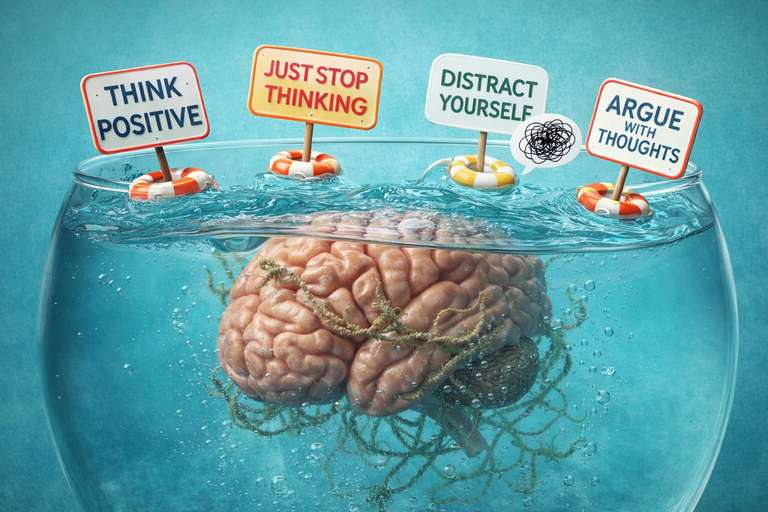
The real problem is not always the content of the thought. Often it is the fact that uncertainty has become fused with threat, and repeated thinking has become the ritual used to try to feel safe again. If that pattern is left untouched, the loop tends to come back, even if today’s thought changes into tomorrow’s.
I think this is where people can be too hard on themselves. They assume they have failed at the advice. Sometimes the advice failed them.
How Overthinking Affects Different Problems
Overthinking rarely stays in one neat box. It attaches itself to whatever already feels important, risky, embarrassing, uncertain, or hard to control. That is why the same underlying pattern can show up in anxiety, sleep, presentations, health fears, relationships, and lots of other areas that look very different on the surface.
The common thread is not the topic, it is the loop. The mind starts scanning, predicting, rehearsing, checking, and trying to get certainty before action. That can make very different problems feel bigger, stickier, and more convincing than they really are.
With anxiety and panic, overthinking acts like petrol on the fire. A small feeling, a strange sensation, or a vague sense that something is wrong can trigger a wave of analysis. You start asking what it means, whether it is building, whether you can cope, and whether this could get worse.
That mental response makes the body pay more attention to the alarm. The person is not just anxious, they are anxiously watching themselves be anxious. That extra layer often intensifies the whole experience and makes the pattern more likely to repeat next time.
Presentation nerves get much worse when the mind starts rehearsing failure instead of simply preparing. People begin imagining going blank, shaking, sounding foolish, being judged, or not recovering if something wobbles. It can feel like preparation, but a lot of it is threat rehearsal in disguise.
Then, during the presentation itself, attention gets dragged inward. Instead of being with the audience and the message, the speaker starts monitoring their breathing, voice, hands, face, or heart rate. That self-monitoring often creates the exact strain they were trying to avoid.
In social anxiety, overthinking often happens before, during, and after the event. Beforehand, the person imagines awkward moments and tries to prepare for every possibility. During the interaction, they monitor themselves closely. Afterwards, they replay what they said and search for signs they got it wrong.
That means one conversation can get turned into a three stage anxiety loop. The social moment itself becomes only a small part of the suffering. Most of the distress comes from the mental activity wrapped around it.
Health anxiety becomes relentless when overthinking joins forces with body scanning. Every sensation starts to feel significant. The mind tries to interpret, compare, predict, and confirm what might be happening. A harmless feeling can quickly become the start of a frightening story.
The more the person checks, researches, and reviews symptoms, the more important those sensations seem. It is not that they are being dramatic, it is that the mind has started treating uncertainty as danger and thinking as the way to control it.
Sleep problems often become worse the moment sleep turns into something you try to control with your mind. People start checking whether they feel sleepy enough, calculating how many hours they have left, worrying about tomorrow, and monitoring whether they are dropping off yet.
That effort creates tension. The bed becomes associated with pressure, frustration, and watchfulness rather than rest. Overthinking turns the whole night into a performance test, which is about the opposite of what sleep needs.
With OCD, overthinking often shows up as mental rituals. The person may review events, test their intentions, seek certainty, repeat internal phrases, or keep analysing whether a thought means something important. From the outside it can look invisible, but inside it is exhausting.
The problem is that each round of mental checking teaches the brain that the obsession mattered and needed a response. That is why trying to think your way to certainty usually feeds the cycle rather than ending it.
With ADHD, overthinking often does not look calm or orderly, it looks like mental traffic. Too many tabs open, too many possibilities, too many half-finished decisions, and a constant sense that something important is being missed. People often ask, why do I overthink everything, when what they are really describing is a mix of pressure, hypervigilance, and a mind that struggles to settle on one clear track.
That can make starting tasks harder, finishing them harder, and recovering from mistakes harder. The mind jumps between options, second guesses priorities, rehearses conversations, worries about forgetting things, and can drift into overanalysing without actually moving forward. Anxiety and overthinking often pile on top of ADHD, which is why learning how to calm an overactive mind can become such an important part of functioning better day to day.
Toilet anxiety is one of the clearest examples of overthinking attaching itself to a body-based fear. The person starts checking sensations, predicting urgency, planning escape routes, mapping toilets, rehearsing what they will do if something goes wrong, and trying to feel completely safe before leaving.
That mental effort does not calm the system for long. It usually keeps the issue live. The body gets watched more closely, sensations feel louder, and the brain learns that the threat must be real because so much thought is being given to it.
In relationships, overthinking can turn ordinary uncertainty into constant emotional strain. A delayed reply, a different tone of voice, or a small change in routine can set off layers of interpretation. The person starts reading between the lines, predicting rejection, or trying to decode every detail.
That can create a lot of pressure in the relationship itself. Reassurance gets asked for more often, tension rises, and genuine connection gets buried under analysis. The person is usually trying to feel safe, but the process can make things feel less secure, not more.
With depression, overthinking often looks like rumination. The mind keeps going back over losses, regrets, failures, missed chances, or painful questions that have no clean answer. It can feel reflective, but often it just deepens the sense of heaviness and hopelessness.
The person is not usually choosing to dwell for fun. They are often trying to understand why they feel as they do, or trying to solve themselves. But repeated rumination can keep the mind locked in the same emotional territory for far longer.
Stress gets much harder to recover from when the mind never really stands down. You are not just dealing with the workload, the pressure, or the demands of life, you are also carrying the constant inner commentary about what might go wrong, what you have forgotten, and what still needs fixing. That is where anxiety and overthinking start to blend into everyday stress.
The result is often hypervigilance, overanalysing, and a mind that keeps scanning for the next problem before the current one has even settled. People looking for overthinking help are often stuck here, trying to work out how to calm an overactive mind when the real issue is that the system has got used to staying switched on. Stress stops feeling temporary and starts to feel like your normal setting.
Confidence drops sharply when every action is preceded by internal debate. The person weighs up how they will come across, what could go wrong, whether they are ready enough, whether they should wait, and how others might respond. By the time they act, they are already mentally drained.
Overthinking makes confidence look like something you must feel before you do the thing. In reality, confidence often grows after action. Too much mental checking delays that learning and keeps people trapped in hesitation.
Gut symptoms and overthinking can become a very tight loop. A sensation in the stomach or bowel gets noticed, then analysed, predicted, and monitored. Very quickly the person is no longer just having a symptom, they are mentally preparing for what it might mean and how to manage it.
That added layer of tension can make the whole experience feel more urgent and intrusive. The gut is especially responsive to stress and threat, so overthinking can end up amplifying exactly the sensations the person is trying to control.
The Common Thread Across All Of Them
What links all of these problems is not that they are the same, because they are not. It is that overthinking adds a second problem on top of the first. Whatever the original issue is, the mind starts circling it, monitoring it, and trying to out-think uncertainty.
That is why overthinking affects so many different issues. It is a process problem, not just a topic problem. Once the brain starts using thinking as a safety strategy, the same loop can turn up almost anywhere.
What Actually Works
A more useful question than how do I stop overthinking is this, what keeps pulling me back into the loop, and what would happen if I stopped cooperating with it? That shift matters. It moves the focus away from trying to produce perfect thoughts and towards changing the pattern itself.
This can involve reducing mental checking, catching reassurance seeking earlier, interrupting rehearsal habits, and retraining attention so the mind is no longer dragged back to the same material every few minutes. Nervous system regulation matters too. If the body is repeatedly going into a threat state, the mind will keep generating explanations, predictions and “what if” scenarios to match that state.
In other words, you cannot always solve the loop by arguing with thoughts alone. Sometimes the system underneath the thoughts is what needs calming first. Then there is belief change. Quite a few people who ask how do I stop overthinking are operating from hidden rules such as “I must be certain”, “I must solve this before I can relax”, or “if I keep thinking, I can prevent something bad.”
Those beliefs can feel sensible, but they often keep people trapped for years. This is why the overthinking programme is the main route from this page. It offers a more structured way of interrupting the loop, instead of leaving you alone with the same mind that has been chasing certainty all day.
If you have been asking how do I stop overthinking for a long time, there is usually a lot of relief in discovering that the answer is not more effort, more inner debate, or more private analysis. It is often a change in pattern.
Overthinking Inside Real Problems
Overthinking does not exist in a vacuum. It often gets attached to real situations, real fears and real sensations. Toilet anxiety is a very good example. A person may start monitoring the body too closely, second guessing each sensation, planning routes, checking where toilets are, rehearsing worst case scenarios, and trying to feel completely safe before leaving the house.
It can look like a practical planning problem from the outside. Underneath, there is usually a strong overthinking loop involved. That is why some people keep asking how do I stop overthinking, but do not get very far until they understand the specific fear structure underneath it.
In toilet anxiety, the overthinking is tied to urgency, escape, body scanning and fear of not reaching a toilet in time. If that is your issue, the toilet anxiety page is the better place to start, because it explains that loop in more depth and makes clear why generic anxiety advice often misses the mark.
That distinction matters. A super ramp like this page should help you recognise the pattern, but it should also point you towards the more specific help when overthinking has become fused with a particular fear system.
If you want to explore related ways we help with overthinking loops and anxiety patterns, these pages may be useful.
Next Steps
If you have been going round in circles with how do I stop overthinking, there comes a point where more private analysing is not the answer. It usually just becomes one more turn of the wheel. For most readers here, the best next step is the overthinking programme. That is the primary route on this page because it is designed for people stuck in repetitive thought loops who want a clearer, more guided way out.
If your overthinking is tied specifically to toilet fear, urgency, route planning, body checking, or fear of not getting there in time, start with the toilet anxiety page instead. That will give you the more specific framework you need.
Overthinking can feel clever while it is trapping you. That is part of what makes it so convincing. But once you can see the loop for what it is, things do start to change. Not always instantly, and not neatly, but they do change. Sometimes that recognition alone is the first real bit of relief people have felt in a long while.