
When anxiety starts interfering with ordinary life, one of the first questions people often ask is, what type of anxiety do I have?
It is an understandable question. A name can feel reassuring. It can make a confusing experience feel more organised. It can also help someone explain what is happening to a partner, employer, friend, GP, or therapist.
But when people are trying to understand anxiety in a practical way, the label is not always the most useful starting point.
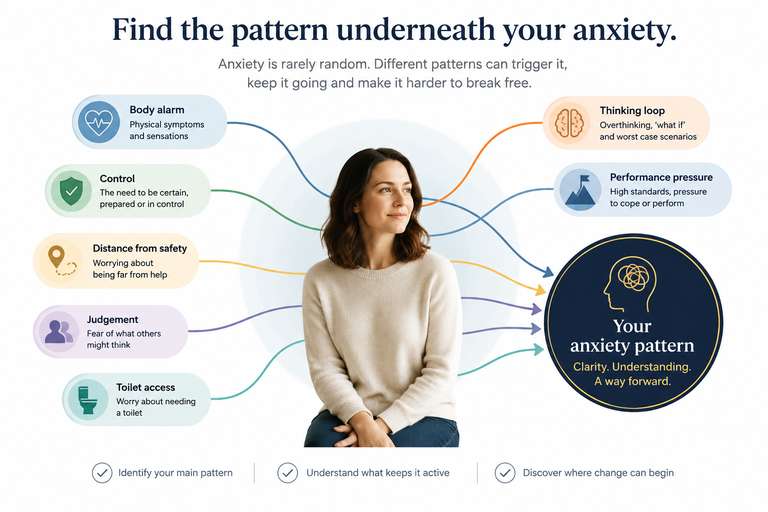
At The Surrey Institute of Clinical Hypnotherapy, we often find that the more helpful question is not simply, what type of anxiety is this? It is, what pattern is keeping this anxiety active?
That shift matters because anxiety does not always fit neatly into one box. Two people may avoid the same situation for completely different reasons. The outside behaviour can look similar, while the pattern underneath is very different.
What Type Of Anxiety Do I Have?
The honest answer is that anxiety can show up in several overlapping ways. Someone may recognise elements of panic attacks, social anxiety, overthinking and anxiety, toilet anxiety, travel anxiety, health anxiety, performance anxiety, or a fear of being trapped. That does not always mean they need a perfect label before they can start understanding what is happening.
A label can describe the broad area of difficulty. A pattern describes the process that keeps the difficulty going.
For example, one person may avoid travelling because they fear panic sensations in the body. Another may avoid travelling because they feel too far from home. Someone else may be focused on toilet access, being judged, losing control, becoming unwell, or not being able to leave easily.
From the outside, all three people might simply say, I get anxious when I travel. Underneath, the anxiety patterns may be quite different.
Why Anxiety Patterns Matter
Anxiety symptoms can feel as if they arrive suddenly, but they are often part of a repeating pattern. There may be a trigger, a body reaction, a thought, an urge to avoid, and a safety behaviour that brings temporary relief. Because relief feels useful in the moment, the behaviour can become more automatic next time.
This is one reason anxiety can become so persistent. The person may be doing completely understandable things to feel safer, yet those same things can accidentally teach the nervous system that the situation really was dangerous.
If someone avoids a train, checks every exit, scans their body for signs of panic, repeatedly asks for reassurance, or mentally rehearses every possible outcome, they are not being silly. They are trying to protect themselves. The difficulty is that protection can become part of the anxiety loop.
That is why understanding anxiety and panic often means looking beneath the headline symptom. The symptom matters, but the pattern underneath tells us more about what the person has been learning, avoiding, checking, controlling, or trying to make certain.
The Seven Anxiety Patterns Used By The Tool
The Anxiety Pattern Finder is a free tool designed to help people understand the pattern underneath their anxiety. It is not a diagnosis, and it is not a formal psychological assessment. It is a structured way of thinking about the different routes by which anxiety can keep itself active.
- Body alarm, where anxiety is strongly linked to physical sensations, panic feelings, or the fear of what the body might do.
- Control equals safety, where the person feels safer when plans, timings, surroundings, or other people are predictable.
- Distance from safety, where anxiety increases when the person feels too far from home, help, familiar places, or an easy route back.
- Judgement and exposure, where the main concern is being seen, evaluated, embarrassed, criticised, or exposed in front of others.
- Access and body trust, where anxiety is linked to toilet access, body reliability, urgency, symptoms, or the fear of not being able to manage bodily needs.
- The thinking loop, where repetitive analysis, mental checking, worry and rumination keep the alarm active.
- Performance pressure, where anxiety centres on having to do something well, cope visibly, speak, perform, decide, or meet expectations.
These are not boxes that people must fit into perfectly. Many people recognise more than one pattern. The value is in noticing which pattern is strongest, which situations activate it, and what the person does next in order to feel safer.
Safety Behaviours Can Keep Anxiety Going
Safety behaviours are the things people do to reduce anxiety, prevent a feared outcome, or make a situation feel more manageable. They can be practical and understandable. They can also become limiting when the person starts to believe they cannot cope without them.
Common anxiety safety behaviours include:
- Avoidance
- Checking
- Reassurance and certainty seeking
- Planning and control
- Escape preparation
- Body scanning
- Restriction and control rituals
- Mental rehearsal and rumination
These behaviours can make sense in the short term. If you check the route, avoid the meeting, stay near the exit, ask someone for reassurance, or scan your body until the sensation passes, you may feel a little safer for a while. But if the nervous system only ever experiences the situation with those protections in place, it may not learn that the situation itself can be manageable.
The Same Situation Can Have Different Patterns
This is where labels can be too blunt. Take a person who avoids going into town. One explanation might be social anxiety, but that may not be the full picture.
One person might be worried about people looking at them. Another might be worried about having a panic attack. Another might need to know where every toilet is before they can leave the house. Someone else might be worried about being too far from home, getting stuck in traffic, feeling trapped in a queue, or not being able to escape quickly.
The label may be similar, but the maintaining pattern is not.
For example, toilet anxiety may involve access and body trust, but it may also involve control, distance from safety, body scanning and repeated planning. Overthinking may look like problem-solving from the outside, but underneath it may be reassurance seeking, certainty seeking, mental rehearsal, or an attempt to prevent imagined embarrassment.
When you understand the pattern, the anxiety often becomes less mysterious. You can begin to see the sequence. What triggers it? What does the mind predict? What does the body do? What do you do to feel safer? What happens afterwards? That sequence is often more useful than a single name.
A Tool For Reflection, Not Diagnosis
The Anxiety Pattern Finder is designed to support that kind of reflection. It asks about how anxiety tends to work for you, then points towards the pattern that may be most active. It does not replace a professional conversation, and it should not be treated as a formal assessment.
Used sensibly, it can help people put words to something they may already recognise. It can also help them notice that anxiety is not just a collection of symptoms. It is often a learned protective pattern that has become too strong, too easily triggered, or too dependent on safety behaviours.
That can be a useful first step. Not because it gives a perfect label, but because it helps the person begin to understand what the anxiety is trying to protect them from, and how it may be keeping itself going.
Next Steps
If you have been asking, what type of anxiety do I have, it may help to look beyond the label and explore the pattern underneath.
The free Anxiety Pattern Finder tool can help you identify your main anxiety pattern, any secondary patterns, and the safety behaviours that may be keeping anxiety active.
After using the tool, you can choose to receive a fuller Anxiety Pattern Report by email.