
Hypnotherapy is a practical profession. People do not arrive as neat textbook examples, they arrive as real people with complicated lives. So if you are looking for hypnotherapy training, the question is not just “what do I need to know”, it’s “can I actually do this work with a person in front of me, under pressure, and still be useful”.
We are passionate about the work, and that is not a slogan. It is not about stacking up students or chasing numbers, it is about the lives our practitioners change when the hypnotherapy training is done properly.
At The Surrey Institute of Clinical Hypnotherapy, we teach in a way that prioritises skill, judgement, and therapist thinking. Techniques are demonstrated first, then practised in small groups, so you are not just taking notes, you are learning how to work with a real person in front of you.
If you already know you want the full diploma route, go straight to the Hypnotherapy Practitioner Diploma course details. If you are still orientating, this page is the overview, it helps you choose the right next step without getting lost in sales language.
We are clear about what we stand against. A lot of hypnotherapy training in the UK becomes too academic and too high volume. Students collect information but do not build enough practical confidence, and clients feel the gap. Good hypnotherapy training should make you more capable in the room, not just more informed on paper.
Training Options And Next Steps
If you are still deciding, watch the Training Videos, read Student Comments, and use the editorial guides linked above to answer the questions people usually feel slightly embarrassed to ask out loud.
Hypnotherapy Practitioner Diploma

The main practitioner route at SICH, what you learn, how the course runs, and whether it’s a good fit for you.
Two Day Hypnosis Course, A Practical Taster

A focused two day course teaching the hypnosis part of the diploma, ideal if you want a proper try before committing to the full HPD.
Diploma Prices And Payment Options
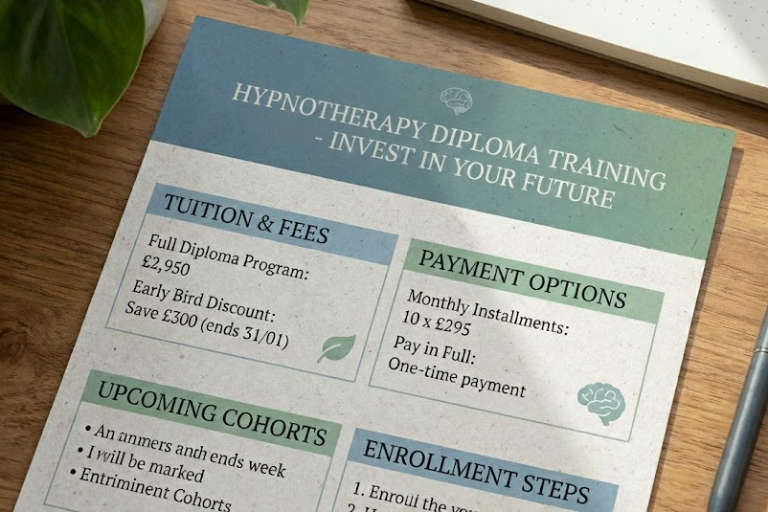
Clear pricing, how payments work, and the practical bits people worry about before they commit.
Download The Prospectus

Get the full details in one place, modules, format, expectations, and what happens next.
Training Videos
A feel for the atmosphere and the people, not polished marketing, just a glimpse of the real thing.
Apply For The Diploma
Ready to take the next step, here’s where you can apply, and we’ll guide you through what happens after.
A Practical Hypnotherapy Training Course For A Practical Profession
Hypnotherapy training is at its best when it turns theory into judgement you can use in a live session. You need the academic material, of course, but most of your progress comes from practice, feedback, and seeing how experienced therapists handle real moments. This section explains what “practical” actually means, so you can spot it in any course, not just ours.
We give you the academic material you need, including a comprehensive manual, but the classroom time is about practical skill, therapist thinking, and what to do when a session becomes real rather than tidy.
Good training is not about collecting techniques. It is about understanding what you are trying to achieve with the client, then choosing the right approach for that moment. When you understand the purpose, you can choose the technique, not the other way round.
During the course you will also see experienced hypnotherapists working with real clients, dealing with real issues as they emerge in the room. That is where students start to think like practitioners, and it is one of the reasons our training stays grounded in reality.
What Hypnotherapy Training Is Really For
When people search for hypnotherapy training, they usually want one of three things, a new career, a credible qualification, or a way to help people in a more direct, human way than their current work allows. But there’s another layer, you are also testing whether you can hold a therapeutic space, stay calm, and guide change without forcing it.
A solid pathway helps you learn the mechanics of hypnosis, but it also teaches you how to think, how to listen, and how to make decisions when a client’s story changes direction halfway through a session. If a course does not help you develop that kind of flexibility, you might still pass assessments, but you can feel oddly unprepared once real clients arrive.
If you want a more personal “is this profession for me” angle, start with Why Become A Hypnotherapist? and then come back here to choose your route.
Who This Work Suits (And Who It Doesn’t)
Hypnotherapy training tends to suit people who are curious about how minds work, comfortable with practice and feedback, and willing to learn by doing. You do not have to be extroverted, but you do have to be present. And you do need to be able to tolerate a bit of uncertainty, because clients rarely follow scripts.
It is probably not a great fit if you want a purely academic qualification with minimal practice, or if you are hoping a certificate will do the “confidence part” for you. Confidence usually arrives after you have done the work, not before. Also, if you are looking for a fast weekend route straight into practice, you might find our emphasis on skill building frustrating, but that frustration is usually pointing at something important.
If you’re in the early stage and want a genuine try before committing, the Two Day Hypnosis Course, A Practical Taster is designed for exactly that.
What You Learn On A Practical Route
Hypnotherapy training is not mainly about learning words, it’s about learning outcomes. You learn how to take a case history, how to identify what the client’s mind is trying to do, and how to choose an approach that fits the person rather than forcing the person to fit the approach. That sounds obvious, but it is where many new therapists get stuck.
You also learn the backbone skills that rarely get marketed because they sound boring, but they are what keep you safe and effective, rapport, pacing, formulation, handling resistance, and knowing when not to push. These are the skills that make clients feel held rather than handled.
If you want a deeper discussion of what to look for when judging quality, How To Find Effective Hypnotherapy Training is worth reading.
How The Training Works In The Room
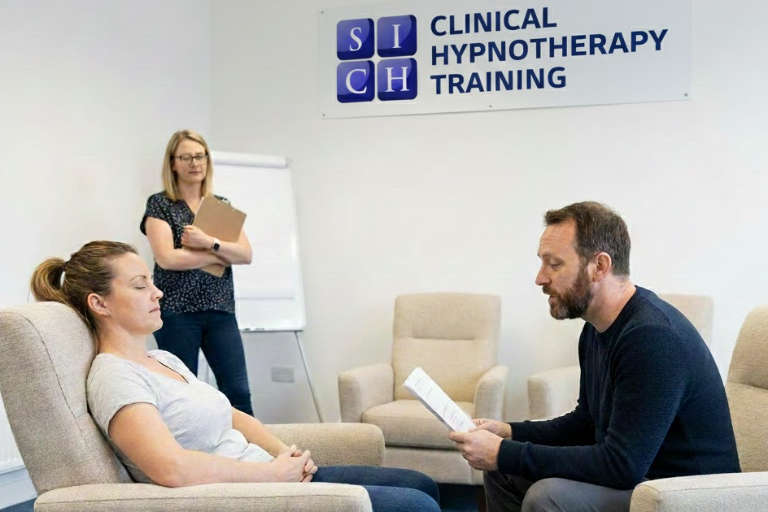
Hypnotherapy training gets real when you practise in front of other people and receive feedback you can actually use. That is why we demonstrate first, then you practise, then you get feedback, and then you practise again. It is repetitive, in a good way, because repetition is what turns a technique into a skill.
You will work in small groups, you will take turns being therapist and client, and you will discover quickly that “knowing” something is not the same as being able to do it while someone is watching. That moment can feel exposing, but it is also where growth happens.
If you have had negative experiences in other learning environments, it might help to look at the tone and approach of our team through the Training Videos and Student Comments pages.
In Person Vs Online, The Honest Trade Offs
Hypnotherapy training is often compared as “online versus in person”, but the more useful question is what the course expects you to do. Theory can be learned at home, and some forms of practice can happen online, but live skill is built fastest when you can be guided in the moment, notice subtle shifts, and get immediate correction.
If you are comparing routes, start with Hypnotherapy Courses Online Or Something Else? and Learn Hypnotherapy Online, What To Look For. They’ll help you avoid the false choice of “online good, in person old fashioned” or the opposite.
For many people, the right answer is blended, learn the foundations at home, practise in a structured way with real feedback, and keep building your confidence until it feels normal.
Accreditation, Regulation, And The UK Reality
Hypnotherapy training in the UK can feel confusing because there isn’t one single state regulator for hypnotherapy in the way people imagine. Different organisations, memberships, and course standards exist, and a lot of marketing language is vague on purpose. This section is here to help you interpret the words schools use, so you can tell the difference between genuine standards and empty reassurance.
Rather than asking “is it accredited” as a yes, no question, ask what the accreditation actually means, who recognises it, what the training requires, and how it protects clients. A good course will be transparent about standards, assessment, practice requirements, and ethical boundaries.
If you want the longer explanation, UK Hypnotherapy Regulation Explained lays out the landscape in plain English.
Assessment, Ethics, And Client Safety
It’s worth saying plainly, the goal is not to produce confident performers, it’s to produce safe practitioners. That means learning how to spot when a case is outside your scope, how to work alongside medical care without pretending you can replace it, and how to handle safeguarding, confidentiality, and boundaries.
Assessment matters because it forces you to organise your thinking, document your work clearly, and show that you can apply what you’ve learned. In good hypnotherapy training, assessment is less about jumping through hoops and more about proving you can be safe, consistent, and clear.
A course that feels “too easy” might be pleasant in the moment, but it can leave you with an uncomfortable gap later, especially when you are faced with complex anxiety, trauma, or chronic stress patterns.
How Long It Takes, And What Progress Actually Looks Like
Hypnotherapy training is not one thing. Some people want a short taster to decide if they like the work. Others want a full practitioner pathway that includes supervised practice and assessment. Time frames vary, but the important question is what happens during that time.
If the time is filled with practice, feedback, and structured learning, you will grow fast. If the time is mostly lectures and reading, it can feel long, and you still may not feel ready at the end. In other words, duration matters less than what the training asks you to do.
If you want to understand the typical route into practice, How To Become A Hypnotherapist is the best starting point.
Hypnotherapy Training Near Me, London, Surrey, And Travel Practicalities
A surprising number of searches for hypnotherapy training are local, “near me”, “London”, “Surrey”. That’s not vanity, it’s practical. Training is a commitment, and if travel becomes stressful, people drop out or stop practising between sessions. So it’s worth being honest about location, transport, and timetable now, rather than hoping it will somehow be fine later.
SICH is based in Wallington, Surrey, with straightforward access from London and the home counties.
Costs, Fees, And What You’re Actually Paying For
Hypnotherapy training costs are not just a number, they are a proxy for teaching time, group size, practice structure, support, and what happens after the course. Price can reflect quality, but it can also reflect marketing, brand, or simply overheads, so cost alone is not enough.
We keep the pricing information separate so it stays clear and easy to update. You can see fees and payment options here, Diploma Prices And Payment Options.
A Quick Checklist Before You Commit
Before you commit to any course, it helps to slow down and ask a few blunt questions, especially if you are comparing hypnotherapy training options across different schools. How much live practice is there, and how much of it is observed by trainers. How large are the groups, and how easy is it to hide at the back. What happens if you struggle, is there support, or are you simply expected to cope.
Also ask what the training prepares you for in the real world. Do they talk about case complexity, client expectations, and the emotional load of the work, or is it all framed as easy transformations and “instant change”. If it sounds like an advert, treat it like an advert.
If you want a sceptical lens on the industry, Hypnotherapy Training Can Train You To Fail is intentionally blunt, and it helps people avoid expensive mistakes.
The Three Most Common Routes At SICH
Hypnotherapy training works best when the route matches your stage. Some people are curious and want a safe first step, some are ready for the full practitioner pathway, and some are already qualified but realise the business side needs attention. The routes below are designed to meet those different moments, without pretending there is only one correct starting point.
Route one is the full practitioner pathway, Hypnotherapy Practitioner Diploma course details. This is for people who want to qualify, practise, and build real competence.
Route two is the entry point, Two Day Hypnosis Course, A Practical Taster. It is a proper experience of the hypnosis part of the work, without requiring you to commit to the whole diploma immediately.
Route three is for people who either already practise or are about to, and want support with the business reality, Hypnotherapy Marketing course details. This is about building a practice ethically and practically, not hype.
If you want to understand the overall pathway first, stay on this pillar. If you want to take action, pick the route that matches where you are right now.
What Happens After Training?
A common fear is, “what if I finish and still don’t feel ready”. That fear is more normal than people admit. The skill tends to arrive in layers, first you can do it in class, then you can do it with friends, then you can do it with paying clients.
The goal is not to remove nerves completely. The goal is to make your skill reliable enough that nerves do not take over. That’s where structured practice, feedback, and support matter.
Dates And Availability
Dates and availability are listed below. For current availability and any questions about which route is the best fit, call our office on 020 8669 6990.